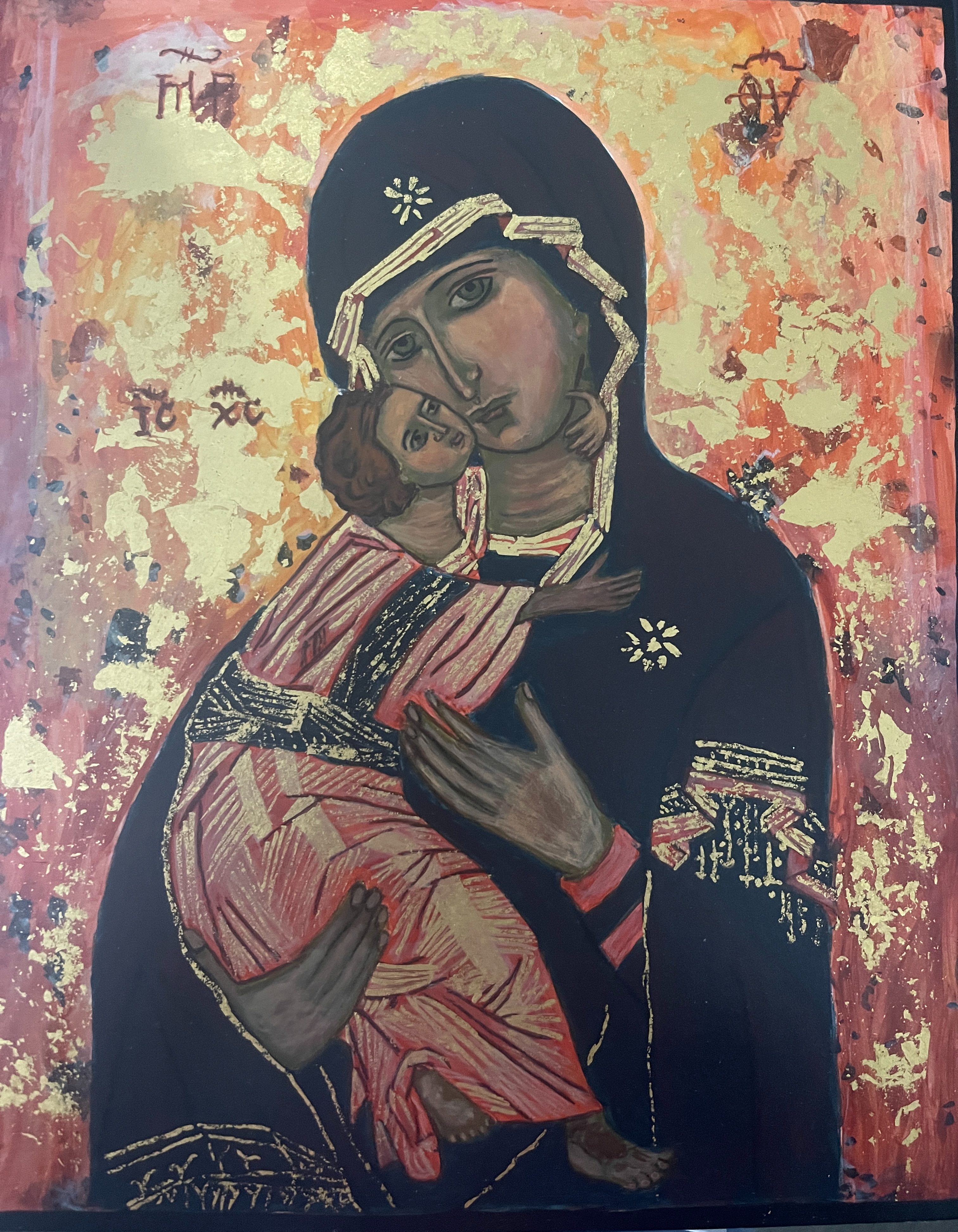
The following is a sermon preached by seminarian Catherine Montgomery, postulant for holy orders, at St. Mary’s Episcopal Church,Jacksonville, FL, on Sunday morning, Dec. 24, 2023.
On the fourth Sunday of Advent, we have one more opportunity to soak in holy anticipation and prepare our hearts for the mystery of the Christmas – that God’s love became flesh and walked among us. If you’ll pardon the pun, we find ourselves in a pregnant pause as we meditate on Mary, the mother of Jesus, before he was born to her and through her, for the whole world. This morning we think about what it meant that Mary was the dwelling place of God, and what that means for us, here and now.
To know Mary better, we must know about the world she inhabited, and her place in the long history of God’s people that stretches much farther back than the annunciation of the Angel Gabriel. And to know Mary better is, of course, to know Jesus better. We have to go back — not just to the manger, and not just to the annunciation, but way back into the Hebrew scriptures.
Let’s go all the way back to the book of Exodus. Long before Mary’s baby was born, the ark of the covenant was the dwelling place of God on earth. The Israelites built a beautiful wooden chest overlaid with gold to hold the stone tablets bearing the commandments. On top of this golden chest there were carved angelic creatures spreading their wings toward one another to create a lid that was called the mercy seat. God told the people that the ark was where God would meet with them and speak to them.
The people built a movable sanctuary around the ark, a tent that moved with them as they wandered in the wilderness for forty years. That’s the background for today’s Old Testament reading from 2 Samuel. A thousand years before the angel appeared to Mary, David was king of Israel. David decided that it wasn’t right that he lived in grand house, but the ark of God was in a tent. He wanted to create a permanent structure for the ark, so that God could dwell in a house at least as grand as his.
But speaking through the prophet Nathan, God said this is not what God wanted. In essence, God said, “Did I ever ask you for a house? I took you from the pasture where you were a simple shepherd, and I have been with you ever since. I don’t need you to make a house for me, instead, I will make you a house…” Notice, God didn’t say that a house will be made for David, but instead that David (and all his descendants) will be made a house with a sure foundation that will last forever. In other words, God said that the people are not in the dwelling place, they are the dwelling place.
Nevertheless, David’s son Solomon did eventually build a grand temple for the ark. According to scripture, the cloud of God’s glory descended from heaven on the temple. The ark sat in the temple in an innermost place called the “Holy of Holies.” So holy and powerful was the ark that no person could touch it. It’s hard to overstate the significance of the ark to the Israelites and the power it held for them as the place where God dwelled.
But the temple was destroyed in a time of war, and the ark was lost, never to be recovered. The temple was rebuilt, but the Holy of Holies was empty – no ark. The ancient belief was that the ark would reappear someday, and that God would once again dwell with the people. At the time of Mary, the people were still waiting faithfully for God’s presence to return in glory.
So when we read that the angel Gabriel announced to Mary that the Holy Spirit would come upon her and the power of the most high would overshadow her, we remember the cloud and the ark. The angel’s announcement to Mary was an announcement to all of us – God is near. This is the great mystery of the incarnation – Emmanuel, God with us.
With the birth of Jesus, God was with the people not for the first time, but in a new way. When the ark was where God dwelled, God was seen as dangerous, set apart, and too powerful to come near. But after that announcement to Mary, God dwelled in human flesh. When Jesus walked among us, God was close and tender, God touched the untouchable and came inside for dinner. God bent low and washed tired and dusty feet. So you see, Mary is honored not just because she was Jesus’ mother but also because in bearing him she fulfilled the hopes of a people that God would again be near them – and not just in some metaphorical, conceptual way — but embodied, incarnate, in the flesh, something they didn’t even know they could hope for.
This is the mystery of Christmas – that God is both powerful and merciful, both everywhere, all the time and in a particular time and place. And amazingly, though we seem to forget it (perhaps because it’s just too wild to believe), the material that God works with is human bodies – not just Mary’s body and Jesus’s body, but yours and mine, and also — every body we love, and every body we can’t stand, every body who ever lived (whether they lived for a day or a hundred years) and every body who ever will live in the future. The incarnation of Jesus leaves no doubt – God works with and through bodies. And friends, the bodies that God uses now to extend love, mercy, and compassion to the world are yours and mine. We are part of the house of David, we are the dwelling places of God.
I wonder… how would we see our bodies, how would we treat our bodies, if we thought of them this way? Whether we are old or young, healthy or sick, big or small… if we’ve had children or hope to someday or not… if our bodies are strong and energetic or just plain exhausted… if our bodies have different abilities, or if they don’t do what we want them to do… if we hold pain in our muscles and joints… if the brains in our heads are peaceful and focused, or anxious and depressed…. How do we see our bodies? How do we talk to our bodies? How do treat our bodies? How committed are we to protecting the bodies of others – hungry bodies here in our city, or bodies trapped in a war on the other side of the world? If we really believed in the mystery of the incarnation — that God dwells in human bodies — aren’t we called to honor all bodies as the dwelling place as God?
Because the truth is that there are not two separate worlds – a spiritual world where God is present and an embodied world where God is not. When God chose Mary — a frightened, confused, unwed young woman from a backwater town in the middle of nowhere — to bear God’s own self into the world in flesh and blood, God revealed to us once and for all that God dwells here on earth, with us, even now.
If this feels improbable or even impossible because we are too anything – too weak, too finite, too mortal, too scared, too anxious, too confused, or too anything – in other words, because we are lowly – may we remember Mary’s song. God has lifted up the lowly.
Together with Mary, may we proclaim the greatness of the Lord with all that we are – with our minds, with our souls, and yes, with our actual bodies, they are the stuff with which God works. Together with Mary, may we linger just a little bit longer in anticipation, wondering what this all means, and building a space within each one of us for God to dwell.
And all God’s children said, Amen.

 walkingwithclare