Unprepared.

(Photo taken of icon gifted to me by St. Francis In the Field parish.)

(Photo taken of icon gifted to me by St. Francis In the Field parish.)

Holy Week is upon us. We follow Christ’s journey into Jerusalem as he enters triumphant and marches toward Golgotha. The days of Lent have been a time of repentance, of stripping down, of anticipating what only Jesus could accomplish for us. As the “last week” begins, I sense some resistance beneath the surface. It seems to come up so quickly. How can we be here already? Though we have walked through this season year after year, there is no way to adequately prepare oneself to witness Jesus’ radical, horrifying act of love.

I visited with a woman this week who is feeling hopeless, who cannot seem to lift herself out of despair, “out of the darkness” that plagues her. We spoke about God and about Jesus. She clings to faith by a thread, frustrated that the prayers and practices that sustained her in the past seem empty and void. All I could do was listen and to wait with her in the silence between words.

It is hard to walk consciously, to stay fully alive to the in-between times. It is tempting to numb ourselves, and our culture makes it so easy. We prefer to live “from glory to glory.” Many of us will move from Palm Sunday straight to Easter, largely out of habit or convenience, ever seeking to accommodate our overscheduled, double- and triple-booked lifestyles. We may assert that we do not have time to observe the progression of Holy Week. But if we can step out of resistance just for a day or two even, and follow the last week with Jesus, Easter will never be the same.

If you attend a church that does not offer special observances during the week between Palm Sunday and Easter, visit one that does. You will be glad that you did.

+++++++
For those in the Jacksonville, FL, area, join our “Church Without Walls” ministry as we enjoy fellowship, hospitality and, following Jesus’ example, wash each others’ feet on Thursday, March 28. For more information, check out our Facebook page at http://www.facebook.com/churchwithoutwalls.Jacksonville.FL. Have a blessed Holy Week!

Posted in Christianity, Diocese of Florida, faith, Recovery, Uncategorized, unity | Tagged , , , , , , , , , , , , | Leave a comment

Prayer of the heart.

heartI spent some time today sharing with a friend who is in trouble, has been in trouble most of his life. He has spent more than half of his time on this globe paying for the wrongs he has committed.

He is charming, witty, bright. A writer of songs and poetry, at times gritty and harshly true. He loves his mama and she loves him. He tells me she knows things about him that she couldn’t possibly know. That’s the way mamas are I want to say, but don’t.

He grills me as a priest, asking me challenging questions about Holy Scripture. It’s complicated; I have no slick, pat answers for you, I say. All I know for sure is that we are to do our best to love God with all our heart and soul and mind and strength and to love our neighbors as ourselves. That’s plenty to keep a person busy.

He tells me he is not so sure that Jesus was anything more than an extraordinary man, a prophet. Wasn’t it weak that he would allow himself to be crucified?

Can you imagine being so in love, so deeply, wildly in love with another, so wanting the best for the other, that you would lay down your life? That’s what God has done in Jesus. He cannot abide the thought of being apart from us. He so wants us to be with him that he was willing to pay the ultimate price.

I tell my friend, nothing you have done, or ever will do, can diminish God’s love for you. You might grieve him, might break his heart a little. But this love is unmovable. God’s mercy is unrelenting and extends to all. Because that is the nature of love.

He tells me that some people here say that a prayer is only good if you end it by saying “In the name of Jesus.” He is not so sure. He says he is most comfortable praying the “Our Father.” You would never offend Jesus by going to the Father, I assure him.

He asks me to read a prayer he had written to the Heavenly Father, a prayer that expresses a deep dream of the heart. He waits for me to object to the content of his dream. Instead I push the prayer across the table. “It’s beautiful,” I tell him. “Keep sharing your heart with God.”

Posted in Christianity, faith, peace, Recovery, Uncategorized | Tagged , , , , , , , , , | 5 Comments

The together.

Recently I heard someone say that Jesus came to create “the together.” This resonates with me. We can find all kinds of examples in scripture where Jesus breaks down barriers and boundaries, bringing people together. He even confronts some of the cultural stereotypes that he and the disciples carried in themselves when he heals the daughter of the Syrophoenician woman (Mark 7:24-30); at first, he dismisses the woman (essentially calling her and her daughter dogs), but when this privileged class Gentile woman tells him “even the dogs under the table eat the children’s crumbs,” she has his attention.

At times we have the power to heal, often through simple gestures of love and acceptance. Sometimes we have the power or influence to help correct an injustice or to smooth the way for someone who may be dealing with the added problem of prejudice. Like speaking up when we know a person of a particular race or ethnicity is next in line but the salesperson or clerk automatically moves to serve the person of privileged status first. Sometimes I act and sometimes I just observe.

What Jesus knows is that we are all of a piece. We are all part of God’s magnificent creation. When one among us suffers injustice, we all suffer. The wound is collective, no matter how remote or removed it might seem.

In his death, resurrection and ascension, Jesus affirms that in God’s perfect economy no one is lost, all are meant to be salvaged and all are made whole. If we wonder where our salvation is to be found, it is in the salvation of “the other.” If we want to find God’s gracious mercy, forgiveness and all-embracing love, we will find it in loving, forgiving and embracing “the other.”

God calls us to reconciliation with all of our brothers and sisters. Or, as my dear professor Gordon Lathrop once remarked: “Whenever you draw a line in the sand to separate yourself from others, you will always find Jesus on the other side.” This, I think has something to do with what the fully human Jesus was working out through his encounter with the Syrophoenician woman. The grace-filled gift of willingness to work through such an uncomfortable process is, I think, fully divine.

20130220-204512.jpg
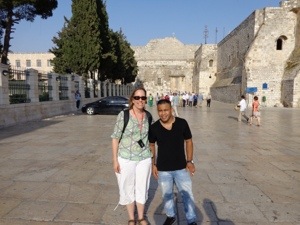
(Photo of a new friend, a Palestinian refugee who waited more than 4 years for a permit to visit the Church of the Nativity and other holy sites in Bethlehem.)

Posted in Christianity, faith, Ministry, Uncategorized, unity | Tagged , , , , | 5 Comments

That you would bless me.

IMG_1130

(Photo taken in my backyard in January 2013)

Today a new friend shared with me how the prayer of Jabez (1 Chronicles 4:10) has been a spiritual aid for her.  The translation she has committed to memory is this: “Oh that You would bless me indeed, and enlarge my territory, and that Your hand would be with me, that You would keep me from evil that I may not cause pain.”

I have not done a careful study of this scripture at this point though I am intrigued.  What I do know is that my friend has been using this to enrich her prayer life, and I can see that God is blessing her.  God is calling her to serve by reaching out to others in our hurting world.  She wanted to visit with me to explore how she might participate in our “church without walls” ministry – a ministry that is developing as God calls us beyond church walls and established ministries to reach out in new, unconventional ways.  My new friend wants to help us create a community that welcomes all – a community that celebrates difference as we care for one another and invite in those who are most often marginalized or forgotten.  This is good, encouraging news.

Before we parted ways, we spoke about the last line in this text: “keep me from evil that I may not cause pain.” In a quick Google search, all I turned up were translations in which Jabez prays to be spared pain.  I much prefer my friend’s version. It is a good thing to pray for God to help us avoid causing others pain.  When I get excited about a new thing, I tend to want to rush out and share it, wanting others to experience the same joy. In those times of high energy and unbridled enthusiasm, it pays to be cautious. My best new idea — unwittingly foisted on another — could have the opposite effect from that which is intended. It could be experienced as overbearing or disrespectful. It is important to be mindful that as ministry develops – as this territory is enlarged — it is wise to pause frequently, to breathe and to check in with ‘the other’ in this emerging community.

Always, it is God who blesses us first. But then we have the opportunity to be blessed again as we make space for a variety of perspectives, not just our own.

Posted in 12-step spirituality, Christianity, congregational development, Episcopal church, Interfaith, Ministry, unity | Tagged , , , , , | 4 Comments

Warm, generous and friendly.

When I googled “hospitality,” one definition that came up described it as “treating guests and strangers in a warm, generous and friendly way.” This suggests welcoming others unconditionally, helping them to feel comfortable and welcomed. Of course there are reasonable limits. You would not want to allow a guest or stranger to treat you abusively or behave in a way that makes other guests feel unwelcome. But, aside from that, hospitality implies tremendous latitude.

I experienced this the first Wednesday we began offering morning coffee to homeless folks lined up outside of a local shelter. We were not far into it, when I was stunned to watch some individuals fill their small foam cups halfway or more with sugar. My immediate knee-jerk reaction was to want to blurt: “Do you really need all that? Is that a good idea?” But I bit my tongue. This is a ministry of hospitality, I told myself, and our guests should take their coffee however they like it. Quickly I moved from a place of judgement to getting a kick out of the multitude of ways people prepare their coffee.

For many (myself included), morning coffee is a soothing ritual, not just in terms of choices about cream and sugar but also in terms of techniques and ways to mix this wonderful beverage. Some put the condiments in first, then the coffee, while others do the opposite. Options for mixing include using anywhere from one to five stir sticks, or instead might involve a technique of pouring the concoction back and forth from one cup to another until just the right consistency is achieved.

Hospitality ought to include allowing people to prepare their coffee just the way they like it, even if a half cup of sugar is not my cup of tea, so to speak. Hospitality involves creating a safe, welcoming space where people can be who they are. Where they can enjoy a cup of coffee just how they would make it at home, if only they had one.

Every Wednesday morning, there is coffee (approximately 450 cups of it!). There is conversation. There is prayer. This is a ministry of hospitality. But it is also a ministry of presence — and it is each person’s presence that truly makes a difference.

“My strength comes with my cup of coffee and the reading of the psalms.”
— Dorothy Day, Christian activist

20130129-171504.jpg

Posted in Christianity, congregational development, Ministry, Uncategorized, unity | Tagged , , , , , , | 2 Comments

Fill the jars.

(Photo taken at Banias, the site of Caesaria Philippi, and source of the Jordan River.)

(Photo taken at Banias, the site of Caesaria Philippi and source of the Jordan River.)

Now standing there were six stone water-jars for the Jewish rites of purification, each holding twenty or thirty gallons. Jesus said to them, ‘Fill the jars with water.’ And they filled them up to the brim. He said to them, ‘Now draw some out, and take it to the chief steward.’ So they took it. When the steward tasted the water that had become wine, and did not know where it came from (though the servants who had drawn the water knew), the steward called the bridegroom and said to him, ‘Everyone serves the good wine first, and then the inferior wine after the guests have become drunk. But you have kept the good wine until now.’ Jesus did this, the first of his signs, in Cana of Galilee, and revealed his glory; and his disciples believed in him. (John 2:7-11)

Today’s Gospel lesson is the familiar story of the wedding at Cana — Jesus’ first miracle.  This morning many will hear jokes about the strong influence of Jewish mothers.  They will learn about the tradition of wedding parties that last for days and the importance of generous hospitality.

As I meditated on this scripture this week the Holy Spirit offered another way into this passage. Consider that we are the stone water-jars – both ‘we’ individually and ‘we’ collectively as the body of Christ.  Already we have followed Jesus into the Jordan. We have repented.  We have found our way to turn back toward God (again and again, for me) and, because he is a God of infinite mercy and grace, we find ourselves enfolded in his love.

Now the work begins. We are commanded to fill the jars with water, to not be stingy but rather to fill them to the brim.  We are to practice the disciplines our faith gives us — praying, studying, worshipping, serving – and to do the next right thing as best we can discern it.  These words are for us as individuals but, even more so, they are for us as a community of faith.  We are to participate actively in our sanctification as a church. We are called to work together, to fill our jars with water, to constantly assess our actions, and to listen to the Spirit. We are called to make course corrections.  Is what we are doing life-giving? Is it merciful, welcoming, loving? Is it just? Does it stack up against Christ’s call to us as laid out in Holy Scripture?

The beauty of the work of filling the jars is this: We aren’t responsible for the results so much as we are responsible for the action.   As Thomas Merton reminds us, we have no idea where we are going but we can trust that the desire to please God does in fact please God.

So we hunker down joyfully.  We fill the jars with water as best we can. And we trust that Jesus will transform us, not just individually but as a community. In this way — by this example — others will come to believe.

Posted in 12-step spirituality, Christianity, congregational development, faith, Ministry, unity | Tagged , , , , , , , | 8 Comments

A river of living water.

Today as we celebrate the baptism of Jesus in the river Jordan, I have been thinking of how Jesus willingly, lovingly entered that muddy river, made his way to John and humbly presented himself. He was willing — and is willing — to take on all that we are and all that we will ever do, or fail to do, in order to gather us to himself. He is relentless in his pursuit of us, not giving up until we recognize and surrender to the truth of who we are and whose we are.

Surely this pleases God to no end. God — who created all things and hates nothing he has made — is Love. Made in his image, we are made for love.

The gospel lesson for today (Luke 3:15-17, 21-22) speaks of how Jesus will take his winnowing-fork to clear the threshing floor, of how he will gather the wheat into his granary but will burn the chaff with unquenchable fire. This scripture used to frighten me. In my sin and brokenness, I worried that I would be swept up with the chaff. What I have come to realize is that the chaff is what mystics call the false self (my ego, my selfishness, the self-protective, self-serving front I sometimes hold up). What I know now is that God intends for none of us to be lost. He desires to heal us with his love so that we can then love others.

20130113-190324.jpg

Posted in Christianity, faith, peace, Recovery, unity | Tagged , , , | 5 Comments

He who is becomes.

theotokasHe who is becomes. The uncreated lets himself be created. He whom nothing can contain is contained in the womb of a thinking soul who stands midway between divinity and the heavy and brittle flesh.  He who is the giver of riches becomes a beggar.  He begs for my flesh to enrich me with his divinity.  He who is fullness empties himself.  … Now he comes to have a share in that which is weakest. (From a treatise by Gregory of Nazianzus, Bishop of Constantinople, 389, found in Readings for the Daily Office from the Early Church, pp. 38-39)

St. Gregory ‘s writing on the miracle of the incarnation is a good reminder to turn all things over to the One who loves us perfectly.  We are called to the heart of the Almighty through an act of perfect love.

It is natural for me to wonder, Am I ready? Am I ready for Advent, for Christmas, for the next thing to which God is calling me?  These days of Christmastide are good days to practice breathing in and out very slowly, to practice letting go.  Advent has come and gone, and I am still here.  Each day is new and holds great promise if I relax and open to whatever the living Christ might have in store. He knows my frailties and shortcomings. And I have learned that is where I can be certain to meet him.

Gregory reminds us that we are created by God in God’s image.  Had the Holy One not breathed his own breath into us, we would remain lifeless lumps of clay.  Today is a good day to practice trusting that God continues to breathe new life into us.  Trust that the One who let himself be created continues to empty himself so that we might share in his fullness.

Posted in Christianity, faith, peace | Tagged , , , , , , , , , | 1 Comment

‘O, the wonder of it all.’

(Photograph of friends taken in June on Mount Tabor, site of the Transfiguration)

(Photograph of friends taken in June on Mount Tabor, site of the Transfiguration)

Ring the bells that still can ring.

Forget your perfect offering.

There is a crack in everything.

That’s how the light gets in.

-Leonard Cohen


This morning a beautiful man shared this simple expression with a small group of friends that sat huddled together enjoying a cup of coffee as the sun came up.  He was quoting his friend Roy, whom he’d met in California more than 50 years prior.  Roy was in recovery and undoubtedly had many stories, many life experiences from which to draw.  But he preferred simply to say this: “My name is Roy, and I’m an alcoholic.” After a brief pause he would add: “O, the wonder of it all.”

It seems Roy preferred to remain plugged into the Great Reality that is the Grace of God breaking into our world and into our lives in a way that is very real.  Miracles happen every day if we will but pause and look around us, if we will pause and see each other.

The true light, which enlightens everyone, is coming into the world.  That light is love, and it gives itself to the whole world.  The promise that is Jesus is the promise of lives transformed again and again. Miracles can and do happen at times instantaneously.  But more often they occur very slowly over time, becoming clear to us only as we look back.  The light always shines in the darkness, and the darkness cannot overcome it.  When this is not immediately apparent, we must lift one another up, and we must reach out to the suffering, to the forgotten, to the unlovable.

Roy understood, I think, that his powerlessness and his shortcomings provided a way for the One who created us all to enter in.

Posted in 12-step spirituality, Christianity, peace, Recovery, Uncategorized, unity | Tagged , , , , , , | Leave a comment

The holy “no.”

(Photo taken at the Church of the Visitation, Ein Kerem, Israel.)

(Photo taken at the Church of the Visitation, Ein Kerem, Israel.)

As we journey this last week toward Christmas, we celebrate the young girl Mary, who without respect to personal cost, said “yes” to the invitation to become the mother of Jesus.  “Let it be with me according to your word (Luke 1:38).”

This “yes” is a good thing.  We are enthralled by the might and power of this event.  If we are blessed enough to sense our own deep hunger that is the voice of God calling us, we can be drawn into a lifetime of asking the question: “To what is God calling me?”  We open ourselves to the grace of the Holy Spirit and pray for the courage to say “yes.”

But what about “no?”  Or, more specifically, what my spiritual director calls The Holy No?  I am not speaking about saying “no” to God but rather about saying “no” to some of the many things that call us into action or engagement in the busy, cacophony of this world.  I am coming to realize that this Holy No is a spiritual discipline about which I know little.  I am finding I need more time.  But not more time so that more activity or projects can be birthed.  I need more time for quiet and prayer.  More time and space to discern those instances when I need to politely yet firmly say “no,” or at the very least “not now.”

This year, when Christmas Eve arrives, when I sing that familiar hymn, I think it will take on a new meaning for me as we welcome in that silent night, that holy night, and with it the promise of heavenly peace.

Posted in faith, peace, Uncategorized | Tagged , , , , , , , | 3 Comments