What was lost is now found.

(photo taken at Memorial Park along the beautiful St. John’s River)

Yesterday I had an amazing morning, walking around for a spell to get a sense of the streets and make some new friends.  I had some friendly encounters, including a rather deep conversation with a very faithful man who, in spite of 18 months of homelessness, has a grateful, prayerful attitude as he seeks daily to find useful, productive activity to keep himself busy.

After that inspiring meeting, I made a last stop at Memorial Park before heading home.  First I ran into a man who was just leaving the park.  He carried a metal detector and told me he had been searching for a friend’s lost ring.  Then I met a young boy who was fishing with his dad and proudly showed me the small fish he caught.  “It’s his first one,” his dad told me.

The most surreal conversation of my morning was with a young man who was standing by the river wall, looking out on the St. John’s River as he listened to an MP3 player.  He was a handsome, young African American man, with meticulously braided hair.  The sun was blistering hot and the river breeze brought limited relief.  I offered him a bottle of water and we stood together, mesmerized by the river.

Our encounter was surreal, not because of what was said, but more because of the energy around it.  We were definitely not alone.  The presence of Love was palpable.  God was with us in those moments.  I learned that Michael was staying with his sister.  He had nearly completed a job-training program out West, when he had to come home to be with family, with his grandmother who was in hospice.  We stood together in silence, taking in the rhythm of the river, and the sense of timelessness that seemed to visit us.  Then I wished my new friend well and went on my way.

There was something so unusual and yet so familiar about that last visit.  Finally today I put my finger on it: as we visited, I had the clear, strong sense of God’s presence that I used to experience as a very little girl, a sense not just of God with us but of God infusing all that is.

These days, I sometimes explain myself by telling folks I have a really simple, naïve kind of faith.  I realize now that what I am trying to describe is that sense of God’s companionship that I had so strongly and clearly as a very tiny child. It was a sense that the wearing of life and cynicism of the world tend to dull by adulthood though usually much sooner.  Could it be that this abiding sense, this naïve faith of mine is coming back, like a precious, misplaced belonging, found at last?  I believe so.

Posted in Christianity, congregational development, faith, Ministry, peace, Recovery | Tagged , , , , , , , , | 4 Comments

Between jobs.

We get so used to the way we expect things to look that we often are unable to see how they actually are.  At times, we get so used to how we expect God to behave that we are unable to recognize when God is doing a new thing.

Recently I visited with someone who has known me as a parish priest.  That is the only role in which she has seen me function.  Knowing that I have moved on to a new ministry,  she took the occasion of our chance meeting to ask more about my new role.

(photo of a friend’s T-shirt)

I handed her my card, which bears the title “urban missioner,” and began describing some outreach activities with the homeless and other at-risk populations. She looked stumped.  Her expression seemed to ask, why on earth would you want to do something like that?

I went on to describe how we are building a bridge between vulnerable populations and people in the pews so that we can learn to serve Christ together.  She couldn’t quite grasp what I was saying, in describing a call that was different from her expectation of what a clergy person is or does.  She couldn’t find an opening to plug this ministry into her worldview.  Soon she quit trying.  She took a different approach, one of reassurance, as she told me: “My brother also was once between jobs for a quite a while.”  I can understand that way of making sense of it; some moments I am tempted to go there myself.

In 12-step meetings, members often speak of the recovery fellowship as a group of “people who would not ordinarily mix.”  The depth, breadth and diversity of membership come as an unexpected surprise to most.  Something amazing happens when a colorful group of folk from all walks of life, with all kinds of abilities and disabilities, get together.  It is as if our minds get blown – or, at the very least, our assumptions.

For once, we know we don’t know it all, not about the others present, much less about ourselves.  So, we must let go and let God.  The Holy Spirit has a way in, to move and to do her thing.  We let go of our old ideas and trust that maybe, just maybe, a new thing is happening. Our hearts and our lives are enlivened.  God is at work.  Transformation happens.

Posted in 12-step spirituality, Christianity, congregational development, Diocese of Florida, faith, Interfaith, Ministry, Recovery, Uncategorized, unity | Tagged , , , , , , , , | Leave a comment

Unbreakable.

(photo taken at Church of the Annunciation in Nazareth)

Recently a stranger from another continent tweeted me, troubled by something someone had told him: that the Bible says to not eat pork (and some other statement I can’t remember now).  I responded that the Bible is chockfull of all kinds of interesting and, at times, contradictory statements that are frequently taken out of context.

In my simple approach to faith, I suggested that if he could channel his energy into learning how to love God with all his heart and soul and mind, and to love his neighbor as himself, that he would do all right.

Julian of Norwich tells us to “hold tight to the Faith of Holy Church.” She goes on to say: “Individuals may often break down – or so it seems to them – but the whole body of Holy Church is unbreakable, whether in the past, the present or the future.”  Lest we be confused, she is good to remind us that the whole body of the Church is Jesus Christ; anything else is extraneous.

These are heartening words in contentious times.  No matter how we wound ourselves or others in our “fight,” it is helpful to remember that “the Saviour’s blessed wounds are open, and rejoice to heal us.” [1]

We are all broken, so it should come as no surprise that the systems we create are faulty.  This is nothing new, so when we find ourselves pining away for how things used to be, we might think again.

Anyone who has ever “hit bottom” with addiction or other destructive behaviors knows that this is a good thing.  With the “gift of the bottom,” a new awareness begins to break into our consciousness.  AA literature calls this pivotal time a “turning point.”  We are invited to let go of “our old ideas.”[2]  We are called to pick up our broken selves and run wholeheartedly into the arms of Jesus who knows us, loves us and longs to transform us into vessels of his love.


[1] Excerpt from Revelations of Divine Love in Readings for the Daily Office from the Early Church, p 314.

[2] Alcoholics Anonymous, pp 58-59.

Posted in 12-step spirituality, Christianity, faith, Ministry, peace, Recovery, unity | Tagged , , , , , , , | Leave a comment

Stand tall.

(photo taken in Tanzania)

Today is the first in a series of Women’s Spiritual Journaling gatherings at a local shelter.  For me, this represents an exciting, new ministry – and also vulnerability.  To show up and report for duty, as I have been taught.  Hoping and trusting that the Holy Spirit will show up, too.  Leaving the results up to God and the beautiful women who walk through the door.

My ego-driven self got sidetracked for a brief spell and threatened to overcome the real, living me with suggestions of last-minute reading to see how “the experts” would facilitate such a thing.  Not a major derailment by any stretch, just that irritating chatter that likes to crash the party.

But then, also unbidden but definitely most welcomed, I heard those words I’ve heard before, coming in a gentle whisper.  In a breeze that traveled stealthily from the Serengeti Plain to my open heart.  Stand tall.  Be the giraffe.  Own and express you gifts, and help others to do the same. The prep work has already been done – it is called living a life of ongoing recovery and discovery.

Bravely uncovering and discovering the stories of our lives, both the surface narrative and the journey between the lines, brings grief and loss as well as joy and gratitude. This process delivers on a promise that our 12 Step friends experience again and again: our past invariably proves to be one of our greatest assets.

Our stories – including those parts that have been nightmarish or uncomfortable — are riches to be mined and shared.  In community, we discover our stories are woven into a much larger, expansive narrative, and we are never alone.   In community, we are graced to dream new dreams.  And, with God’s help and the love of each other, we are graced to live into them.

Posted in 12-step spirituality, Christianity, Diocese of Florida, faith, peace, Recovery, small group ministry, Uncategorized | Tagged , , , , , , , , , , | 9 Comments

Letting go of barriers

(icon photographed in Nablus at site of Jacob’s well)

When I was a little girl, I remember learning about barriers, most clearly by walking into them.  I remember going to McCrory’s downtown when I was tiny and causing a stir when I tried to drink from a particular water fountain.  I didn’t understand why I couldn’t have a drink of water.  But what baffled me as a toddler apparently made perfect sense to my mother and to the kind old African American custodian who stopped me from committing such a terrible error.

We like to classify things.  My grandmother “Bangy,” who was born in 1901, had a book on her shelf that was ancient even by her standards.  It was entitled The Classification of Things and attempted to sort out all manner of things, from leaves and twigs to bugs and butterflies and even some man-made things.  It was strange and funny, so off the mark it clearly was when held to the light of current science and plain old common sense.

We like to classify people.  And, once we do, we like to sort them out, to segregate them according to our understanding.  After the categories have been established for a while, they become barriers, even walls, that appear unmovable.  We become so accustomed to their presence that we are unable to imagine a different world.

We are called as a church to bring a prayerful, discerning eye to our practices and ways of doing business.  Tradition is a beautiful thing and yet we must always be willing to critique ourselves as an institution.  I think of my brilliant, loving God-filled liturgical theology professor Gordon Lathrop who encouraged us to constantly ask of our work as a community: Is it drawing us closer to God? Is there room for the living spirit of God to be present and do its work among us or are we running the show? Is what we are doing hospitable?  Who is not here? Whose voices are missing?

Maybe we spend too much energy trying to entice new people to come inside our sanctuaries.  Perhaps we feel obligated to focus first on increasing our “average Sunday attendance” because we have so much invested in real estate and property.

We need churches.  Physical space can be a wonderful, vital tool for all kinds of gatherings.  But we also need to break out of that space and our addiction to it. We need to learn to be in relationship with one another if we are to have any chance of being in relationship with the living God. In this age of crowding cities and a plethora of social media tools that enable us to communicate with hundreds, sometimes thousands, of friends with a few clicks, we are in some ways even more isolated than ever.

Down here in the “South,” people are fond of saying that we need to have a personal relationship with Jesus.  I have no beef with that.  But if we want to know Jesus and if we want to share him with others, then we need to do what he did.

We need to visit each other in our homes, or better yet on our porches. We need to hang out at the well and be open to whoever shows up.  All are welcome.  We need to spend time with and pay particular attention to those who have different life experiences and different worldviews.  They have something important to teach us.  We need to do a lot more walking, talking and simply being with the other and a lot less “surfing,” tweeting and, dare I say, blogging.

As I seek to practice what I am preaching here, I am sure there will be times I will be shut down by fear of venturing into new territory or will experience the doubt that can come with inevitable setbacks.   I will share both successes and failures in this space, as well as with my friends – new and old – at the well, on the street, under the bridge, on the porch and “in the rooms” — and even at church.

Posted in Christianity, congregational development, Episcopal church, faith, Ministry, peace, Recovery, Uncategorized, unity | Tagged , , , , , , , , | Leave a comment

“Live what you express.”

(photo taken at site of Nabot’s fields, Israel)

This quote comes from a sermon by St. Augustine, Bishop of Hippo.[1]  Sounds a lot like an expression commonly heard in 12 step communities: You can’t just talk the talk and expect to get anywhere – you’ve got to walk it.

Augustine encourages us to “sing to the Lord a new song,” but to be careful that our actions don’t contradict our words.  He admonishes us: “sing with your voices, your hearts, your lips and your lives.”

Augustine is telling us that, if we are careful to practice the principles of living well – if we strive daily to love God with all our hearts and souls and minds and to love our neighbors as ourselves — then we not only will be praising God through our actions, we ourselves will become God’s praise.

Hallelujah!


[1] Wright, J. Robert, Readings for the Daily Office from the Early Church. New York: Church Publishing Inc., 1991, pp 290-291.

Posted in 12-step spirituality, Christianity, faith, peace, Recovery | Tagged , , , , , , | Leave a comment

The way home.

20120624-151149.jpg
This afternoon, we have a little down time on our pilgrimage. A number of folks have headed out to various walking destinations in Jerusalem. I have opted to spend some quiet time in my ‘cell.’ In part, this is due to feeling a bit puny (a few days ago I forgot my rule to never eat ground meat in a foreign country), but just as much it reflects a need to decompress and find a sense of grounding.

Taking in so much in a short period of time can be overwhelming: visiting numerous holy sites and historically significant destinations, spending time in prayer and worship, and getting to know new friends. Hearing heartfelt stories from people who have lived their entire lives in the midst of the Israeli-Palestinian conflict. Muslims, Jews, Arabs, ex-patriots. Franciscans from Italy, Sisters of Mercy, Arab Christians, Palestinian Christians, German Christians. Heart-wrenching stories. If we listen with compassion, we hear human suffering, frailty and hope on every side. One of our guides tells us, “If you are confused, that’s a very good sign.”

Definitely, it’s complicated.

But there is one aspect that is simple. That is universal. We all long for a sense of home. Physically. Spiritually. Emotionally. There have been moments on this glorious journey when I find myself longing for home, ready to return to those places and relationships that give me a sense of wholeness and connection.

Pictured here is a simple mural. It remembers a place of peace and tranquility, where quality of life is possible for all. In it, one can detect that deep sense of longing we all share. The longing for home.

***********
On a side note, various folks at home have been asking about the new ministry upon which I am embarking — ministry that will build a bridge between our neighbors most at risk and those among us (churched, unchurched or “dechurched”) feeling a need for a deeper ministry of action, of ministry with those who are different or most often overlooked. “What will it be called?” is a question I get asked a lot. This has caused me some anxiety because I simply could not come up with a name. A couple of nights ago I got the brilliant idea to ask God to provide a name. In the middle of the night I woke up with the words “The Way Home.”

In the coming weeks, with the collaboration of those who feel drawn to this kind of welcoming community, more will be revealed.

In the meantime, how does the name “The Way Home” strike you?

Posted in Christianity, congregational development, Diocese of Florida, Episcopal church, faith, Ministry, peace, Uncategorized, unity | Tagged , , , , , , , | 6 Comments

Sheer silence.

Today we visited the Church of the Annunciation in Nazareth. Before we arrived here, though, we went to Caesarea Maritima, and revisited scripture from Deuteronomy and from Acts. We considered what it means to be called to vocation and noted how so often God calls us to work for which we feel ill-prepared. Work we would never choose to do, left to our own devices.

We considered the story of Elijah in 1 Kings 18-19, how he was charged with defying Ahab and Jezebel as he routed out the prophets of Baal — a ministry that had risen up because of Jezebel’s foreign influence.

In the process of reflecting on this over dinner with friends, I realized I made an embarrassing error in my last blog entry. I confused Isaiah and Elijah, having named Isaiah as a figure in an icon when in fact it was Elijah. At times when I find I have made an error like this — in front of God and a fairly sizable number of folks who follow my blog — I want to hide in my shame and embarrassment. But that is a worn-out routine for me.

Instead, I’d like to practice what Brene Brown calls shame resilience. To own it and move on. (Or as our 12 step friends say, “when we are wrong, we promptly admit it.”) The truth is, my careless or ignorant errors don’t matter so much in the grand scheme of things — they even serve a purpose in keeping me humble. The beauty of it all is that God can use my work to do some good even in spite of my errors. But, still, there’s that part of me that would prefer to be right, to look good at all times.

So, Elijah routed out the prophets of Baal, seeing to it that they were killed. They had already acknowledged they made a mistake and could now recognize the God of all. Was Elijah doing God’s will by showing them no mercy? It’s hard to tell. His actions don’t make him look so good.

Right or wrong, God is there for Elijah. He has him wait on the mountain to encounter his Lord. Elijah finds God, not in the wind, not in the earthquake, not in fire. He finds God in sheer silence — a silence that must have been so powerful, so profound.

At the Church of the Annunciation, I encountered this very modern sculpture of Mary. In it, I see a power so vast, so mighty that it drowns out everything else, creating a silence that is deafening. Perhaps Mary encountered a power so great that she was willing to say “yes, let it be with me according to your word.”

20120619-212546.jpg

Posted in 12-step spirituality, Christianity, faith, peace, Recovery, Uncategorized | Tagged , , | 4 Comments

Sustained in the desert.

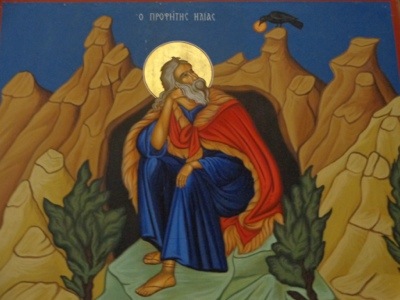
Today we visited a handful of holy sites, the first of which was Jacob’s well, which is housed in a Greek Orthodox monastery and church. The eldest priest there is a gifted iconographer who has spent the past 3 or 4 decades creating magnificent icons that are placed throughout the space of the church. The sale of original copies helps to sustain the church and gives pilgrims something special to carry home.

The icon pictured here is of Elijah being fed in the desert by a raven. The message is clear: God will take care of our needs although often the particulars — the substance and the delivery system — are not what we would choose for ourselves.

12-step wisdom reminds us that “we get what we need, not necessarily what we want.” Sometimes it takes us a while to recognize how blessed we are by what we are given, especially when it does not match our expectations.

Elijah is dumbfounded when God calls him to service. He is not fit for such work as far as he can tell. And if he is obedient, he will surely face death.  But the Holy Spirit fills in the gaps. The Holy One has compensated for human deficiency.

The woman at the well, the Samaritan woman, is startled to be addressed by this man Jesus (John 4). She is startled to be acknowledged, much less to be seen for who she is. She comes to the well understanding her role as a woman — to fetch the water — and yet she is able to let go of her assumptions as Jesus speaks with her. She is able to receive Living Water that will never run dry.

20120618-193034.jpg

Posted in 12-step spirituality, Christianity, faith, peace | Tagged , , , , , | Leave a comment

Bare necessities.

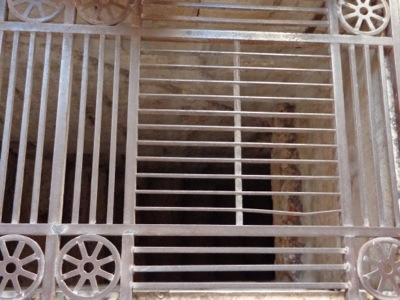
St. Jerome spent more than 30 years translating Holy Scripture into the Vulgate (Latin) so that the word of God could be accessible to ordinary folk.

This is a photo of the gate leading down to the small cell where he worked (located at the Church of the Nativity in Bethlehem). The stark simplicity of these quarters invites us to reassess how much we really need in the way of material things in order to do the work God calls us to do.

As I enter a new ministry with the poor and those on the margins, it serves as a strong reminder that little is required beyond the most basic necessities. Little is required beyond the power of the Holy Spirit and a willing heart.

20120617-080937.jpg

Posted in Christianity, congregational development, Diocese of Florida, faith, Ministry, Uncategorized | Tagged , , | Leave a comment