Convincing Jeremiah.

Jeremiah was a reluctant prophet. Today, from the Mt. of Olives, we caught this glimpse of his home town Anatot. I can imagine him growing up, a rambunctious Preacher’s kid, running around and never imagining that God would call him to be a real prophet. But God did just that. He called Jeremiah to be a truth-teller gifted with the power to discern hypocrisy at the highest levels. He empowered Jeremiah to speak the truth — to speak a message that separated him from the power-pleasing court prophets.

God said that if Jeremiah could find just one person in Jerusalem who acts justly and seeks truth that he would spare them all (Jer 5:1).

It is easy for us to think that those were particularly shameful times, that surely someone of such virtue could be found under ordinary circumstances. The closest that any of us can come is to work toward this standard, relying on the help of God and the support of each other. The human power of one is never enough — but we make progress when we work together, when we can be vulnerable and speak the truth about our own shortcomings.

And when one among us has the courage to speak truth to power and then finds himself or herself thrown into a cistern of mud, let’s pray that we don’t simply look the other way. Let’s pray for the courage to lower a rope in the light of day and help our brother or sister out.

20120614-211722.jpg

Posted in Christianity, faith, Uncategorized | Tagged , , , , , | Leave a comment

The hand of God.

(photo downloaded from Dreamstime)

In Anam Cara: A Book of Celtic Wisdom, John Donohue’s description of intimacy speaks of what I have come to know as being present with another.   When he speaks of “intimacy as sacred,”[1] he uses the example of a mystic who spends years sitting in silence before the Presence, before ever being ready to make an approach.  This suggests the need to develop a capacity for patience, not only for tolerating long stretches of silence, but also for developing a sense of peace within them.

Donohue writes about how the idea of intimacy has been used and abused in our culture and how various forms of media, including the Internet, result in overexposure that masquerades as intimacy.  He wrote this before the explosion of social media sites and the phenomenon of blogging in which writers are able to share from the heart.

I am conflicted about (and often overwhelmed by) all of these vehicles of communication.  Yet here I am praying and striving to be honest and real in the “blogosphere.”  Every so often I feel something like bile rise up in my throat – I want to interpret it as writer’s block when in fact it may well be my soul’s deep desire for self-preservation, to step back into that space of silence, of being reserved and anonymous.

Don’t get me wrong. I appreciate being connected with friends near and far, keeping up with significant life-changing events, even as we enjoy the mundane, as we challenge each other in Words with Friends and “like” each other’s FaceBook status.  There is no way I could stay connected with so many with whom I have walked during various seasons of life.  This is a good thing.  But so might be the occasional fast from such activity.  Easy access to social media and Internet technologies does not circumvent the need to connect with each other face to face. It does not satisfy the yearning that can only be touched by sitting in the presence of the other.

“‘The hand of the stranger is the hand of God.’”[2]

Something happens when we are truly present with the other.  When we pause and take a deep breath.  When we really look at the one we are with, look beyond the surface.  If we listen closely – as if we are listening not for words but for a breath, for the rhythm of a heartbeat and the sound of cells dividing – in this space we begin to encounter our neighbors, not as we imagine them to be, but as they are, holy and complete.  We may find that we see not only children of God but the embodiment of God.

This is easier said than done.  I encountered it in a very profound way in the somewhat controlled environment of an 8-day silent retreat with about 16 other folks from very different places and points on the spiritual journey.  We sat together in meditation for a few hours each day.  We observed silence for the entire time, not speaking with one another until the last day.   The sense of intimacy and community that was born in that time was palpable.  That practice of patiently waiting in silence, day after day, created something within us and among us that we could not have achieved if we had spent those days sharing with each other from the heart.  In the silence we found an intimacy that was deeper and more profound than what we would have encountered in our most vulnerable, spoken stories.

The same can happen when we are willing to reach out to our neighbor who is different.  What we do for one another can be significant but it is never as deeply life changing as the slow, consistent process of being present.

As I step away from ministries at St. Francis and our beloved Glenmoor community, I am grateful for the ability to remain connected through technology and social media. I am grateful to all who choose to follow this blog and to share it with others; in a sense a community is springing up among us in this space, and I hope it is a blessing.

As I move forward, privileged to launch a new ministry in Jacksonville – a church without walls – I look forward to meeting others who long to explore a yearning to go into the world, sharing the grace and love of Christ with neighbors, especially those edge dwellers – folks who often feel like the “out” crowd rather than the ”in,” no matter where they may appear to fall on the “social scale.”  I imagine a church without walls that welcomes all – those who feel invisible or shunned by society or organized religion and those who are looking for a way to live out their faith that has meaning and embodies the Spirit that is Love.

Donohue tells us that “the stranger does not come accidentally,” but comes bearing surprising gifts.  As we reach out to the strangers among us, may we each find all manner of gifts.  May we each find the hand of God.


[1] Donohue, John. Anam Cara: A Book of Celtic Wisdom.  New York: Harper Collins Publishers, Inc. 1997. pp 17-19.

[2] Ibid, p 18.

Posted in Christianity, congregational development, Diocese of Florida, Episcopal church, faith, Interfaith, peace, unity | Tagged , , , , , , , , | Leave a comment

The only way out.

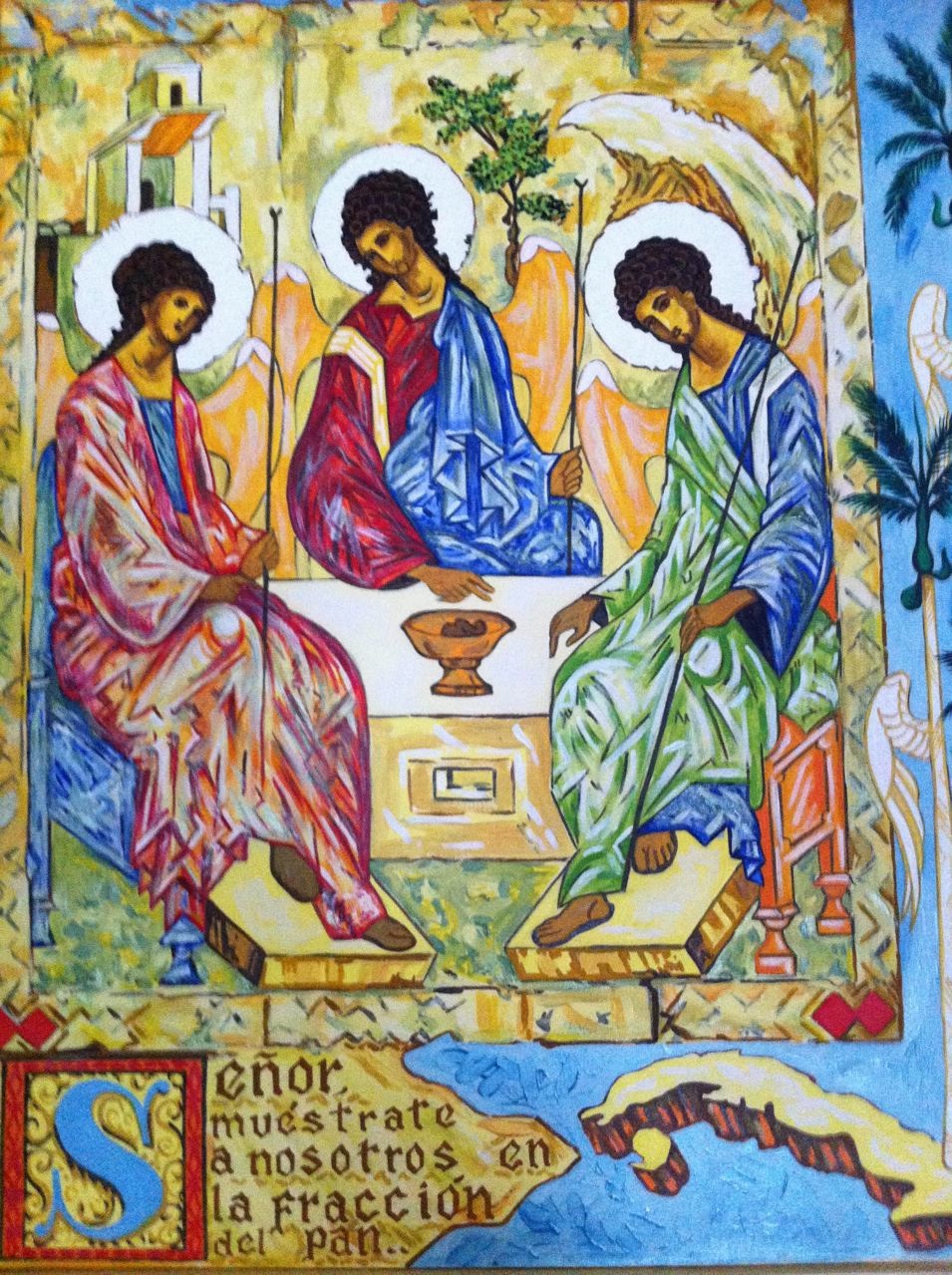
(Icon written by Eduardo Santana of Bolondrón, Cuba, and generously gifted to me on my last Sunday at St. Francis In-the-Field.)

“The only way out is through.”  These wise words were spoken to me some three decades ago, during my initiation into a way of life based on the 12 steps of recovery.  The friend who shared this wisdom was communicating the importance of not only acknowledging but also delving into the baggage that I had accumulated thus far.  This jibes with the recovery wisdom that tells us that our past is our greatest asset – if we are willing to mine it for all it has to teach us about ourselves, about being human and about growing into the awareness that we are part of God’s magnificent creation. That we are loved and embraced where we are.  And that we can never hope to get to where we’d like to be without acknowledging and accepting where we’ve been.

Sadly, the dear friend who imparted this wisdom to me – the only way out is through – is no longer with us.  He chose many years after our friendship began to end his own life.  A mutual friend tracked me down in California to share this painful news.  Many of us, who together had found recovery in the early 80s, were still around to try to piece together a sense of what went wrong.  Much had transpired for each of us since those early days; it had been years since any of us had been very close to our friend.

As I think now about our friend – and as I explore this beautiful icon, often referred to as the Old Testament Trinity, illustrating Abraham’s three visitors at the oaks of Mamre – I cannot help but think of the importance of community.  We need each other.  I need you.  It is true that no human power can relieve our greatest difficulties, that we must depend on a power greater than ourselves.  But we learn this and we are reminded of this in the context of community.  The rich, revealing stories of others give me hope to imagine a new story for myself.  The honest gift of such stories reminds me that God never gives up on us.

My particular faith tradition turns first to Holy Scripture as the source of all things necessary for salvation.  We also rely on the rich tradition of the community of faith that has come before us, practicing faithfulness and service to God and neighbor.  And we also rely on the gift of reason.  We practice our faith together, in community, and we prayerfully reflect on our lives.  We find God revealed in scripture, in worship and in the faces and lives of one another.

In many ways, this way of life — echoed in the 12 Steps — is a lovely, subtle example of liberation theology, a way of living and growing in faith that has been falsely appropriated and politicized by a few pundits.  On close examination, this theology presents a beautiful way of being in community that offers hope and transformation for those often marginalized or otherwise rejected by systems of power and privilege.

Our 12 Step communities do teach us “the only way out is through.”  But, just as important, they teach us that this is a way of life that is lived together, in community.  It is a spiritual journey that is grounded in “we, not I.”  The wisdom embodied in the phrase “The only way out is through” still rings true.  But it will only work for the long haul if we remember also “the only way out is with.”

Posted in 12-step spirituality, Christianity, Episcopal church, faith, Recovery | Tagged , , , , , , , , , | 2 Comments

The gift of encouragement.

(Icon written by Eduardo Santana of Bolondron, Cuba.)

“I want your voice on my GPS,” my friend Kate remarked a few years ago.  She was driving a group of us to a retreat at Holy Cross Monastery, along the Hudson River.

As often happens when traveling “country” roads, the GPS directions sometimes miss the mark.  This required some brief backtracking more than once.

Apparently I was doing once again that thing that comes so naturally to me that I don’t think twice about it.  “You’re doing a great job, Kate. You are awesome.  Thank you so much for taking care of us in this way.”

What seems like a knee-jerk, habitual response on my part is apparently a “spiritual gift.”  I’ll take it.  One could be known for a lot worse habits than that of encouraging others.

These days, though, I find myself the recipient of encouragement from others – from some who know me well and long and from others whom I’ve just met.  A few months ago, when I began exploring the possibility of a call to work with those typically relegated to the fringes, I visited with a number of clergy and lay people and was astounded and humbled by the encouragement and support I received.  I sent an email to a retired priest in Maine, hoping to connect with some of her colleagues in the Boston area. Almost immediately, she phoned me to give me some sound direction but mostly to encourage me to follow and nurture this sense of call. She forwarded a spreadsheet – today’s version of a Rolodex – sharing contact information for an informal society of folk doing similar work.

As vision for a new ministry here in Jacksonville takes shape, I have begun to meet with lay persons and clergy alike, some “churched” and some “unchurched” and, again, have received nothing but enthusiastic, encouraging words (not to mention offers to help with much-needed gifts of time, talent and treasure).

This morning I attended a conference on mental health and spirituality.  It is impossible to be a force for healing in this world without engaging the mental health community and those committed to their own mental health, as well as ensuring our neighbors have access to adequate mental health services.  I was stunned to learn that Duval County (where I live) is the lowest funded county for mental health in the state of Florida, which happens to be the second lowest funded state in the nation (Alabama leads the way with the lowest funding for mental health).  All the more reason for the church to work cooperatively to bridge the oftentimes enormous gap in care for our community, especially for our most vulnerable folk.

It seems we may be on the right track in the Episcopal Diocese of Florida.  As urban missioner, I will be privileged to work with many beautiful people, as we share the love of Christ in shelters, community centers and on the street.  If we are careful and intentional, we will build a community of equals, learning from those we serve and journeying to places beyond our wildest imagination.

Posted in Christianity, congregational development, Diocese of Florida, Episcopal church, faith, Interfaith, peace, Recovery | Tagged , , , , , , , , | 2 Comments

With a leap, a whistle and a fart.

With a leap, a whistle and a fart. These words are borrowed from Holy Fools & Mad Hatters by Catholic priest and contemplative Edward Hays.  My dear friend Betsy gifted me with this book as I headed off to divinity school four years ago.  Through it, Hays invites us to become “fools for Christ,” to let go of the need to look good and to become willing to accept the loneliness that at times accompanies faithfully living out a particular call to serve God.

This makes for sound advice for my dear friends graduating this weekend from Yale Divinity School and Berkeley Divinity School at Yale.  I want to tell them to go out from that amazing place “with a leap, a whistle and a fart.”[i]  And, of course, along with that, to carry a continuing commitment to prayer.

This line (”a leap, a whistle and a fart”) has caused me to chuckle of late, because it is so free, happy and undignified.  Doing the next right thing is a formula for freedom and happiness but it also can be a bit undignified.  Especially when it involves self-care of a physical nature.

Recently I acquiesced to the advice to have a benchmark colonoscopy screening for colon cancer.  The prep was not lovely but the procedure itself was no big deal in that I got to have a great nap.  When the GI doc checked in on me, he informed me that I have a “flip-floppy” colon so he was only able to view a portion of it. He left the more discouraging news for the nurse practitioner to deliver.  I will have to do another “prep” and return for an Xray for which I will remain awake and during which I may have to perform some “exam table calisthenics.”  My apologies for this revelation of TMI.  But, to make my first point: if you are “of a certain age,” maybe you’ll join the club and get screened as well.

The second point is less invasive but worth considering: our spiritual journeys can seem a bit “flip-floppy” at times.  In my experience, it is rare to move directly from “point a” to “point b.”  More often we travel in a spiral motion, through which we may seem to visit the same experience or lesson more than once.  Such times, it is easy to misjudge our progress as regression (“I’ve been here before”) rather than to recognize that we are indeed growing.  Life presents us with many rich, though sometimes painful experiences – experiences that can be mined in new and deepening ways over time.  In 12-Step programs we are taught that our life experiences are our greatest assets.  Those we would prefer to not repeat can nonetheless be sources of information and learning if we will allow ourselves to explore them with open minds and the guidance of a trusted spiritual companion.

According to the nurse practitioner Ben, my colon isn’t simply a “flip” and a “flop” but rather it appears to comprise a series of twists and turns.  Ben is quite fascinated by this but even more so by the fact that my colon works just fine, that I am indeed a “regular gal.”  While my initial reaction to all of this has been irritation that I have to go through another process in 2 weeks (rather than in the expected 10 years), I am beginning to embrace this journey.  I am choosing to view my colon, with its series of twists and turns, as a sort of internal labyrinth – a metaphor for the journey toward a deeper and closer relationship with God and self.  I would never in a million years have planned that journey the way it has played out to date.  But I wouldn’t give up a single twist or turn no matter how foolish it makes me look.

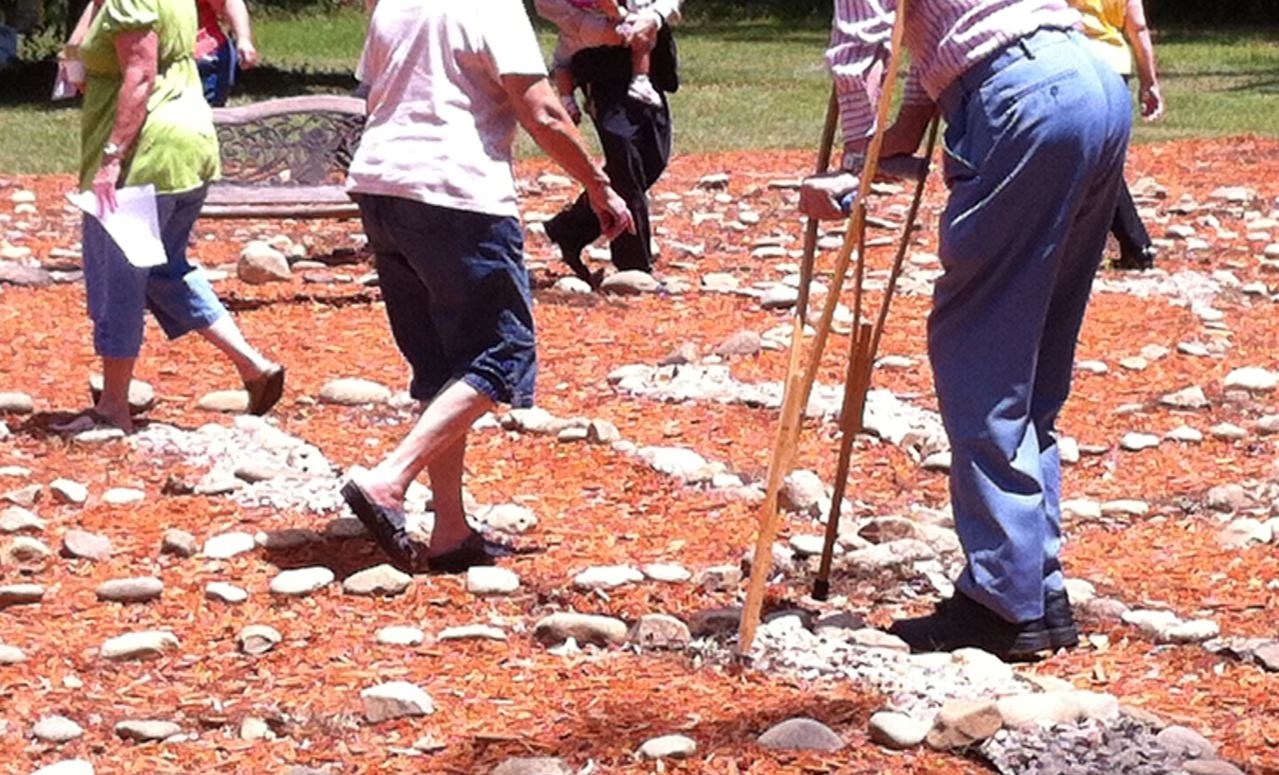
(Walking the labyrinth with some other “holy fools” — the beautiful people of St. Francis of Assisi in Tallahassee, FL, on May 5 for World Labyrinth Day.)


[i] Hays, Edward, Holy Fools & Mad Hatters: A Handbook for Hobbyhorse Holiness, p 165.

Posted in 12-step spirituality, Christianity, Diocese of Florida, Episcopal church, faith, Recovery, Uncategorized | Tagged , , , , , , | 5 Comments

Gratitude for my St. Francis family

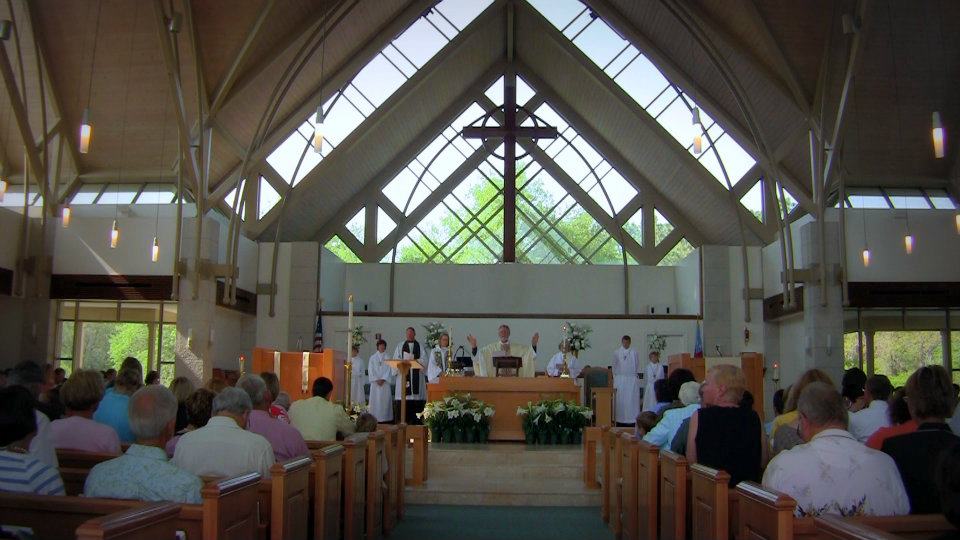
(Photo on loan from our parish Facebook page)

The following is my final sermon at St. Francis.  Thank you Father Michael, Joan, Jackie, Deacon Linda, Kim, Dominique and Jason — and all of you beautiful people.  Thanks to Len and the beloved Glenmoor flock.  Your prayers and love have helped to shape me, and I give thanks to God for each of you!

*****

Sixth Sunday in Easter/St. Francis in the Field

Acts 10:44-48; Ps 98; 1 John 5:1-6; John 15:9-17

“Abiding in God’s love”

Today is Mother’s Day, and I want to recognize

all of our mothers present today.

We tend to associate with motherhood

that nurturing, life-giving kind of love that embodies

the tenderness, mercy and unconditional love

we seek to find in God.

My own mother – beautiful Sarah Marie –

passed away 15 years ago.

It was a Sunday afternoon the day before

she was to begin treatment for lung cancer.

I was to travel back to Florida the following week

to help with her care.

I felt like I was pestering her, I had been calling so much.

But dialed her again.

“I’m just calling to say I love you!”

“I love you, too.  Always remember that.”

Those were the last words we exchanged –

I’m so grateful they were words of love.

I wish that my mother had been alive to meet all of you

(she would have loved you so much)

and to see me get ordained.

But I know that, nonetheless, she shares in my joy.

In fact, one Wednesday morning,

shortly before I left for seminary

I attended the 7 a.m. service at the Cathedral.

Connie, a long-time, deeply faithful parishioner –

in her 90s and who stands less that 5 feet tall –

grabbed my arms during the peace.

She looked up into my face and said:

“This morning an angel told me your mama

is running all over heaven bragging on you!”

If you’ve ever met Connie, you know better than

to doubt what she says

when it comes to the heavenly realm.

As we celebrate our mothers today —

and as the mothers among us enjoy this day —

it’s important to keep in mind that

this can be a painful time for some.

For those who perhaps never got to know their mother.

For those who’ve lost children or

For those who never had children.

Please be careful to never assume that

a woman is childless by choice.

For me, a big piece of healing around that kind of grief,

came several years ago.

One night I had a really vivid dream.

I found myself standing in a large room, filled with cribs.

I was the only adult present in this nursery,

and quickly figured out

that I needed to pick up these children

to feed and care for them.

At one point I picked up a toddler and took him

to the big open window,

Together we looked at the vast expanse of the world and

I showed him some of things he ought to know.

In my simple, innocent, sometimes naïve faith,

I could hear God say:

See.  You are going to be a mother –

just of a different sort than you imagined.

I have many, many children who are waiting for you.”

No matter where we find ourselves in all of this –

on a day like this, we are blessed to have scripture

that calls us to abide in God.

To abide in his love.

It calls us to see what has been described

as the Maternal Face of God.

When we do this – male and female both –

we are able to treat one another

with compassion,

and we are able to let the Holy Spirit

mother us wherever are.

In that space of abiding in love,

all manner of wounds are healed.

Wrongs are forgiven, and we are set free.

By sending us the Holy Spirit, Jesus assures

that we are never alone.

The Spirit comforts us when we need comfort.

It prays for us and advocates for us in our time of need.

The Spirit convicts us, inspires us and empowers us.

If that isn’t a description of the very best possible

Mothering, I don’t know what is.

If we can get ourselves out of the way just a bit,

the Holy Spirit has the space to move in and

do amazing things.

This parish’s new and deepening commitment to Cuba

is a great example of what can happen

when we allow the Holy Spirit

to have her way with us.

A couple of years back, I doubt that Father Michael

anticipated he would be traveling to Cuba so often.

I’ll bet there are those among us who were thinking,

“Shouldn’t we be putting our energy elsewhere?

Shouldn’t the focus be growing the church or

Building new classrooms?”

The blossoming of this ministry has interrupted

our “business as usual” in a wonderful and holy way,

just as Peter’s eloquent speech was interrupted

when the Holy Spirit fell upon a group of Gentiles.

In that moment Peter was able to see that

there was only one indicated next step:

to baptize the foreigners with water because

God already had baptized them in the Holy Spirit.

These other practical matters –

determining whether to require circumcision

or other Jewish observances –

these would be resolved in good time.

The Holy Spirit doesn’t wait around for us

to get our administrative ducks in a row.

She does her work and trusts that we’ll catch up.

Many of you were at St. Francis,

when I served as an intern here years ago.

Some of you beautiful faithful people have

held me in prayer all these years.

I am deeply grateful for your commitment.

You have nurtured me as I have grown in the

process of becoming a priest, pastor and teacher,

here and in World Golf Village where

our small group ministry was initiated last year

with the leadership of the Wheelers,

and with participation by the Luttons and

some of our Glenmoor community.

As more are led to be involved,

that ministry will grow and flourish.

Being open to the movement of the Holy Spirit is

what keeps ministry fresh and alive.

Many of you who have heard me preach even

a handful of times know that it is not uncommon

for me to talk about the poor,

to talk about those who tend to be forgotten or

overlooked in our society.

This does not make for easy listening.

Believe me, I share in that sense of discomfort.

The gospel message has always been challenging.

Jesus’ words have always been countercultural,

whether we examine them in the context of his earthly ministry

or in the context of ours.

He calls us again and again out of our comfort zone.

That is the nature of Love.

Love places the well being of the other first,

Love is not content to let things remain the way they are.

Love is always seeking new ways to manifest itself,

to reach those who are starving for love.

John’s gospel today calls us to abide in this love.

It tells us if we do, then we will bear much fruit.

We will love our neighbors, near and far.

We will offer ourselves, expecting nothing in return.

A few months ago, I met up with a retired priest to talk about

some of what I was experiencing in my new vocation.

I told her:

“I can’t stop preaching about the poor

and the disenfranchised.

It keeps coming up.

It seems to dominate the lectionary and

when I pray and meditate on the appointed lessons,

these are the stories

that speak to my heart.”

She listened to me patiently.

Then she looked me square in the eye, and asked:

“Did it ever occur to you that this keeps coming up –

not so much so that you will preach this message

to this congregation —

maybe it keeps coming up so strongly because

that is the work God is calling you to do.”

Her question got under my skin.

I began exploring the possibility of a ministry

more closely aligned with those on the margins.

Over the last few months, in prayer and in conversation

with Bishop Howard, Father Michael and others,

my next steps have become clear.

I will be leaving St. Francis at the end of this month

to serve as urban missioner for the diocese,

focusing on at-risk areas –

working with the most vulnerable among us.

But this ministry will not be done in isolation.

It is not a ministry of one.

A key part of my work will be

to create a bridge and a support system

for people who feel called to ministry

beyond the parish walls.

This ministry is rooted, first and foremost,

in a call to serve as the real presence of Christ,

sharing his love through worship and sacrament –

sometimes in unlikely places —

and through fellowship, prayer and ministry

with the men, women and children

most at risk in our communities.

This work will take me beyond the walls of St. Francis

but I could never leave you completely.

You have played a huge role in raising me up,

in nurturing me and shaping me.

The breadth of your faith never ceases

to humble and inspire me,

and the depth of your love touches my heart.

I fully expect to work with you in some capacity

as we play our small parts in helping

to usher in the kingdom of God.

Each week, we come to this table.

We receive the elements of bread and wine,

trusting that Christ is present with us.

May we bring open minds and open hearts.

May we remain flexible and responsive to

the movement of the Holy Spirit.

May we learn to expect the unexpected.

Above all, may we receive the grace to abide in his love –

and the strength to love our neighbors, near and far.

AMEN.

Posted in Christianity, congregational development, Diocese of Florida, Episcopal church, faith, Uncategorized, unity | Tagged , , , | Leave a comment

Temporary housing.

The mornings have grown fairly warm, but we all know the real summer heat has yet to arrive.

Last week, I rode with a small, dedicated team as they visited a few old friends, including one woman who has been fending for herself on the south side of town for at least a decade. She moves frequently, staying one step ahead of the next frustrated person or business ready to run her off.  She has no intention of coming inside, of seeking shelter.  She trusts no one who is part of the system.  But she looks forward to visits from the shelter outreach staff and appreciates their care.  While the professionals were preparing her meds, she and I chatted.  Her theology proved to be sound.

(photo taken in Duval County, FL)

“Why are there so many different kinds of churches, when there’s only one God?” she asked me.

“The problem is not with God but with people,” I told her.  “We like to disagree and argue about things.”

She seemed to take this in, to ponder it for a moment.  She took me by surprise when she shifted gears.

“There’s so much suffering,” she remarked.  “Why does God allow so much suffering in the world?”

Excellent question.  I told her that God doesn’t like suffering.  She searched my face as she nodded in agreement.  “God cares a great deal about your suffering,” I told her as she gazed into the distance.  She didn’t respond.

Posted in Christianity, faith, peace | Tagged , , , , , , | Leave a comment

In the vesper light.

(photographed at south Ponte Vedra Beach)

Late yesterday I was privileged to attend an interfaith prayer meeting.  Though we concluded our time by breaking bread together, enjoying a feast in the salt air and getting to know one another, the primary purpose of our gathering was not one of dialogue or of educating each other about our respective faith traditions.  We came together simply to open our hearts in prayer.

We listened to beautiful recordings of the Lord’s Prayer and of the Unity Prayer of the Baha’i faith.  We shared readings from the New Testament, the Old Testament, and the Bhagavad-Gita.  We heard snippets from Thomas Merton and other spiritual writers.  We listened to beautiful heart-born prayers from the children who joined us and to the wisdom of the elders amongst us.  We laughed and we loved and we celebrated that place within, where each human being hungers for the Creator of all.

And, behold, at the setting of the sun, he appeared on the beach.

Posted in Christianity, faith, Interfaith, peace, unity | Tagged , , , , | 2 Comments

Radical unprotectedness.

(photographed in the backyard, after a much-needed storm)

Earlier this week, as I was fishing for information on St. Francis of Assisi, I came across a phrase attributed to Simon Tugwell, who describes Franciscan spirituality as “a way of radical unprotectedness.”

The meaning of “unprotectedness” seemed obvious to me so I looked it up, just to be sure. Webster’s defines it as “a property of being helpless in the face of attack.”  Not very satisfying.  Not very Franciscan sounding, if you ask me.  It misses the point.

For me, this phrase speaks not so much to helplessness as it does to vulnerability – a willingness to expose oneself, to risk being open to others and most of all to God.  “Radical unprotectedness,” I think, is the willingness to abandon myself to God, to trust his love for me enough to let go of the ‘idols’ I might be relying on to give me a sense of safety (i.e. a high level of productivity, financial resources, the love and approval of others).  Radical unprotectedness is not something we achieve but rather something we strive for, as we move through the process, again and again, of recognizing what we are holding back and then releasing it to the One who is perfect Love.  It is a willingness to sit in the discomfort or awkwardness of that season of letting go, that space of surrender.

Many years ago, I had a dream in which a strange man (God) was using a cutting tool, to cut away a large section of my face.  I patiently endured this process, only asking a moment here and there to rest before giving in once again to this cutting away.  This was not a process of eliminating me, but rather a process of removing the masks I had taken on so that my true self could be revealed.  My prayer is for the willingness to let go of resistance, to allow this process to continue to take place.  To allow myself to become that unique part of God’s creation – the “me” that God intends.

As I reflect of late on the process of the 12 steps of Alcoholics Anonymous, I am grateful for simple instructions that invite us into a journey that is profound, a journey into a life that is not lived for ourselves only.  This journey is captured beautifully in the following poem, which was first shared with me by my dear friend and “sister from another mother” — the beautiful Rev. Rainey Dankel.

Mother Wisdom Speaks

Some of you I will hollow out.

I will make you a cave.

I will carve you so deep the stars will shine in your darkness.

You will be a bowl.

You will be the cup in the rock collecting rain…


I will do this because the world needs the hollowness of you.

I will do this for the space that you will be.

I will do this because you must be large.

A passage.

People will find their way through you.

A bowl.

People will eat from you

and their hunger will not weaken them to death.

A cup to catch the sacred rain….


Light will flow in your hollowing.

You will be filled with light.

Your bones will shine.

The round open center of you will be radiant.

I will call you Brilliant One.

I will call you Daughter Who is Wide.

I will call you transformed.

— by Christine Lore Webber, published in Woman Prayers, edited by Mary Ford-Grabowsky.

Posted in 12-step spirituality, Christianity, faith, peace, Recovery, Uncategorized | Tagged , , , , , , , , | 2 Comments

Four amigos.

This morning I had the privilege of meeting with four gentlemen – “pillars of the community” – who were hoping I would serve on a small community board with them.  I couldn’t imagine why they would want me – I have no clout, no power, no money.  Turns out they wanted me for my “youth.”

At my age, how can I turn down a pitch like that?

More than one of these gentlemen has been acquainted with my family since before I was born.  After all these years, to get to visit with them and to learn just a bit of the hard work they have been doing all this time, quietly behind the scenes, was inspiring.  Helping troubled, disadvantaged youth and giving them opportunities and support so they at least have a small shot at a productive life — a life that isn’t marred by repetitive incarceration or premature death — is just one example.  These men hope not only to sustain their current efforts but also to expand and extend them to other pockets in our community where poverty and the ills that accompany it thrive.

Unlike many of their much younger counterparts, these men are from a generation that doesn’t make a fuss about what they are doing, so all of this good work was news to me.  They simply go about their business, pursuing justice quietly.  And relentlessly.

This is going to be fun…

Posted in Christianity, faith, peace, Recovery, Uncategorized | Tagged , , , , , , , | Leave a comment