A doorway called lament

This morning’s Daily Office includes Psalm 88.  Despite my resistance to it, I was pulled into this poetry of deep lament and carried forward to the final words: Darkness is my only companion.

The conveniences and devices of modern life enable us to dance around that place of darkness, to find welcome distraction with a simple click.   And yet, in the end, that easy avoidance does not lead to contentment or peace.  Even when we have hundreds of “friends” on Facebook, these tools do not guarantee that experience of genuine connection that we so deeply crave.

If we truly want to connect – if we want to be in relationship with others and with God – we must first connect with ourselves.  We must embrace (or at least acknowledge) who we really are rather than who we wish we were.  Those who practice the recurring cycle of the 12 Steps know the sense of “coming home” that blossoms as we reach that point where we can pray the seventh-step prayer without reservation:  “My Creator, I am now ready for you to have all of me, good and bad…”

The psalmist does something we all must do from time to time.  He vents.  He pleads.  He complains.  He blames.  His friends and family have turned against him, have utterly abandoned him.  When they are gone and he finds himself alone, he blames God.  He lets his frustration and fear and discouragement run their course.  And then he knows he is truly alone, accompanied only by darkness.  He is empty and he can no longer deny it.  Now he has a chance.

(Photo taken at Bridge of Lions, St. Augustine, FL)

Posted in 12-step spirituality, Diocese of Florida, Episcopal church, faith, peace | Tagged , , , , , , | Leave a comment

Welcome to the edge

All Saints day is one of four Principal Feast days, commonly marked by the administration of baptism.  Today (and this coming Sunday) we celebrate all those who are members of the Body of Christ, as we “express the intercommunion of the living and the dead in the Body of Christ” (Holy Women, Holy Men, p. 662).

At St. Francis In-the-Field we will celebrate this Feast Day by lighting candles for loved ones who have died and placing them at the altar.  We will also celebrate the baptism of one of our newest members – a three-month-old little girl.

In some congregations we commemorate All Saints by singing the familiar hymn “I sing a song of the saints of God,” which often accompanies a procession of a number of folk dressed to represent a wide variety of gifts and the vocations through which they are expressed.  It can be a little hokey, but I must admit I get choked up every time.  Regardless of how you feel about that particular hymn, we could do with a regular reminder that each person in our midst – and all whom we encounter – has God-given gifts.  God desires for each of us to identify and steward these gifts, to grow and flourish, to be productive and contributing members of the human race.

On Sunday, our candles will be placed in wooden racks, lovingly designed and built by one of our parishioners.  Our baptism will take place at the beautiful font pictured above and crafted by a parishioner. We are each recipients of God’s gifts and graces, and our job in life is to figure out how best to cultivate and share those gifts with our neighbors.  Sometimes, though, we need a time of healing, a period for developing trust and a relationship with Christ and the church (the people).  We aren’t all able to jump in right away.  Sometimes we need to be able to put a toe in the water, to retreat for a time, and then to return and try again.  Sometimes our journey to the threshold of Christian community is long and bumpy.  We may need to rest along the way.  That needs to be okay.

Since coming to St Francis in June, I have been intrigued and delighted by a uniquely situated church pew.  This pew does not sit in the sanctuary or even in the parish hall.  It sits outside, providing a place to pause and rest in the sunshine and fresh air.  At first I thought: This is too beautiful and valuable. It should be moved inside.  But now I get it.  Part of welcoming someone in is to allow them space to linger around the edges.

(photos taken at St. Francis In-the-Field, Ponte Vedra, FL)

Posted in Diocese of Florida, Episcopal church, faith, peace | Tagged , , , , , | Leave a comment

The center holds

This morning I found some old papers from graduate school, from when I studied creative writing at the University of Southern California.  It was May 1992.  One of our teachers assigned our motley crew of fiction writers the following exercise: Write a letter to God. Then, write a response from God.  This was not meant to produce fiction but rather was intended to get us to take a snapshot of our understanding of our relationship with God, good, bad or indifferent.  The only parameter was that our letters should be no longer than ½ page each.

I complied with this exercise quite willingly.  Our instructor was known mostly for his stint as a lead writer on the groundbreaking show Laugh-In.  However, he was quite candid about his practice of the 12 Steps of recovery, so I knew his interest in our doing the exercise came from a place of great integrity and of love for us as young writers.  At that time, I was attending church hit-or-miss, studying meditation, and keeping to myself that crazy thought that kept coming to me in quiet moments: priest.

The letters below were written nearly 20 years ago. If I were to do this exercise again today, I doubt that the result would be measurably different.

Dear God,

If I could change things, there would be no more injustice or oppression or poverty, no more them and us.  There would be no more politics of any kind, correct or otherwise.  People would know better than to act like they have power over others. People would love each other, and life would be fair.

We would have difficulty imagining that at one time fifty percent of all African American men were chronically unemployed.

There would be no more hate crimes, because there would be no more hate.  There would be no more hate, because there would be no more fear.  Every man and every woman would know who they are.  They would be whole.  All children would be safe.  No one would be alone or forgotten.

There would be nothing to write about.


Dear Beth,

I am.

I am infinite mercy, infinite forgiveness, infinite compassion, infinite love.

You are my hands, my feet, my voice, my body in the world.

Pay attention.

 ******

(Chinese farm art purchased in a market in Shanghai)

Posted in 12-step spirituality, Episcopal church, faith | Tagged , , , , , | Leave a comment

When dreaming becomes a contact sport

Marty is interim rector at a small parish in my diocese.  We visited recently and he showed me around, walking me all over the property and pointing out various improvements to the “physical plant.”  He is a dreamer but not the kind who is content to leave the work to others.  His energy is contagious.

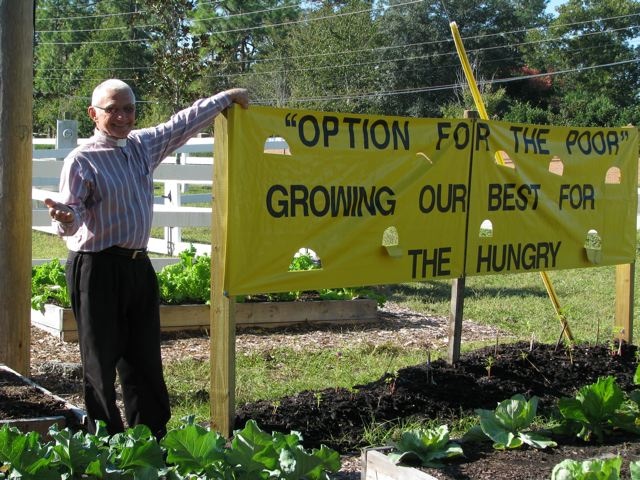
One project he showed me is a small organic garden, which was recently planted on the church grounds, easily in view of passing traffic.  A bright yellow sign speaks of the “option for the poor,” which hearkens to Matthew 25 and is a theme running throughout liberation theology.  Jesus tells us we will always have the poor with us – but he does not mean that we should give up, that we should ignore or abandon the plight of the poor.

Jesus has a heart for the poor and the hungry.  He has a heart for the neglected, the marginalized, the forgotten.  Marty tells me that all of the beautiful produce from this garden goes directly to a local program that feeds the hungry.  Fresh, gorgeous, highly nutritious life-giving food.  This program came about because of the vision of a single parishioner who felt called to start a garden.  It came about because she responded.  She said “yes” to the Holy Spirit and shared her dream with Marty.  It came about because Father Marty supported her in this; he did not allow the way things have always been to stand in the way of what might be.

I have always thought of interim ministry as a very special form of service, but one of people who serve more as stabilizing placeholders, until the “permanent” priest is hired, than as facilitators of emerging ministry.  But, if we are honest about it, all priests are interims (parishioners, too).  None of us is here permanently.  And I doubt the Holy Spirit is deterred by whether a priest is “interim” or not.

Jesus didn’t call us to follow him and serve others once we get settled.  He doesn’t recommend tabling decisions and actions until someone more qualified comes along.  He calls us to address need as we encounter it day to day.

“Come, you that are blessed by my Father, inherit the kingdom prepared for you from the foundation of the world; for I was hungry and you gave me food, I was thirsty and you gave me something to drink, I was a stranger and you welcomed me, I was naked and you gave me clothing, I was sick and you took care of me, I was in prison and you visited me.” (Matt 25:34-36)

As a priest asked to lead and explore an emerging ministry, my takeaway from my time with Marty is to listen carefully to God and to the community around me. To dream dreams and to take action as opportunity presents itself.  Where this road will lead is not my concern.  Only God knows.

(photo of Father Marty Pfab, taken at St. Patrick’s Episcopal Church, Jacksonville)

Posted in congregational development, Diocese of Florida, Episcopal church, faith, St. Clare of Assisi, Uncategorized | Tagged , , , , | Leave a comment

The challenge of a new thing

This morning’s Daily Office includes Ezra 3:1-13, which describes the beginning of rebuilding the temple in Jerusalem, following the return of Israelites from the Babylonian exile.  In verses 10-13, the new foundation has been laid, and so the people gather for worship.  A great shout rises up from among them.  This great sound is marked by shouts of joy that the temple is being restored, but it also includes cries of agony and loss from those who remembered the temple as it had been before, in all its glory.

As we learn to be church together, our communities sometimes are divided into two camps: those who long for the way things used to be, and those who are certain a completely new thing is just what is needed.  In Ezra we find a people who are building on the essentials of what they have known, but at the same time there is a sense that this is indeed a new temple.  As we look to rebuild existing ministries or to begin something altogether “new,” we may be well served – or rather, we may serve well – by remembering the foundation that is essential, by remembering the church as it is modeled for us by the first followers of Jesus, in particular through the intimate house churches, described in the Book of Acts.

The foundation remains unchanged.  But as we celebrate the expression of the Gospel as it emerges in and through those who gather now, let us acknowledge that some in our midst cannot help but struggle with a sense of loss.  Let us remember that as new life emerges, it does so on the heels of death.  With celebration at the emergence of something new, there also comes a sense of loss.  Let us be gentle with one another as we journey forward.

Small groups forming for community, Bible study and worship in St. Augustine World Golf Village.  For details, send a message through the St. Clare of Assisi Facebook page or a Twitter message to StClareofAssisi.)

(photo taken in chapel at Epworth By-the-Sea)

Posted in congregational development, Diocese of Florida, Episcopal church, faith, small group ministry, St. Clare of Assisi, Uncategorized | Tagged , , , , | Leave a comment

Resilience is something we do.

At a clergy retreat earlier this week, we focused on the topic of clergy wellness.  The approach was holistic.  We discussed wellness as it pertains to our physical, spiritual, emotional and social lives.  In his closing homily, our Bishop related this theme to this Sunday’s gospel lesson as he underscored that self-care is integral to living out the commandment to love our neighbors as ourselves.  Experience was our teacher as we shared various strategies for getting the support and direction we all need from time to time if we are to live in a way that is life-giving for us and for those with whom we live and work.

This notion of resilience as a way of acting in the world speaks to our ability to respond to ever-changing circumstances.  To the extent that we are able to be flexible, to adapt or to find new ways of approaching or overcoming challenges, we are able to realize health – a sense of wholeness — in body, mind and spirit.  Often this requires the help of others.  Often it requires God’s help.

Yesterday marked the feast of Saint Luke the Evangelist, the Gentile, physician missionary who was a contemporary of Paul.  Luke is widely considered the author of both the Gospel of Luke and the Book of Acts.  Holy Women, Holy Men notes that “only Luke provides the very familiar stories of the annunciation to Mary, of her visit to Elizabeth, of the child in the manger, (and) the angelic host appearing to shepherds” (p. 644).  These are all stories that demonstrate resilience – the ability to respond to changing, even startling, circumstances in a way that is life-giving.  To do so requires a childlike trust in God.  A trust that all will be well.

Resilience is something we do.  Resilience is moving forward in faith even and especially when we don’t see the full picture.  It is a practice to which we are called as followers of Christ.  This is something to remember as we move forward in any ministry.

Next week, we begin our first small group meeting for the new diocesan ministry we are calling St. Clare of Assisi.  This ministry draws on the tradition of house churches that is first attested in the Book of Acts.  We will gather for prayer and study but most of all for fellowship with each other and with God.  What is next for this ministry?  Prayer, study, persistence.  Listening to the Holy Spirit and to the people we hope to serve.  And, most of all, obedience to Christ.  An obedience that comes in the form of resilience.

(photo taken at clergy retreat at Epworth-by-the-Sea)

Posted in congregational development, Diocese of Florida, Episcopal church, faith, small group ministry, St. Clare of Assisi, Uncategorized | Tagged , , , , | Leave a comment

Only everything.

Folks in Alcoholics Anonymous often give prospective members the following reassurance: We will only ask you to change this one thing — EVERYTHING.  Them thar are fightin’ words.  A person would have to be pretty desperate to stick around to hear more.

Fortunately, for the addict or alcoholic, desperation is something with which he or she is most definitely familiar.  Sometimes it comes in an intangible form, as simple as the desperate hope to not be “found out.”   At other times it is more obvious: the desperation that comes from ruined health, obliterated relationships, homelessness or imprisonment.  Sometimes it gets that bad: a person’s outside conditions match the sheer desolation of their inner life.  But for those with “high bottoms,” skid row only manifests on the inside. In the end, it is this sense of utter bankruptcy that helps us become willing.

These truths may not be as obvious to the non-addict, but they apply to everyone.  What motivates us to let go of those habits, behaviors or attitudes that stand between us and God or between us and our neighbor is most often the realization that this thing is killing us in some way.  It is often a very subtle action, a slow killing, if you will.  Something that chips away at our soul or our integrity, bit by precious bit, until we come out of the fog of our unconsciousness some morning to find we are lost in the midst of this life we have so carefully constructed for ourselves.  Though we may not feel it at the time, this place of “coming to” is a very good thing.  It can bring us to the place of willingness that is our soul’s long awaited gift – the chance to abandon ourselves and our lives utterly to God.   This God who loves us completely has been with us each step of the way.  This God holds us gently.  Holds everything that is.  We need only let go.

Small groups now forming in St. Augustine-World Golf Village area for community-building and Bible study.  Check out the St. Clare of Assisi Facebook page at https://www.facebook.com/pages/St-Clare-of-Assisi-a-ministry-of-the-Episcopal-Diocese-of-Florida/119634524805140?ref=ts

(Image of celtic cross downloaded from Dreamstime.com)

Posted in 12-step spirituality, congregational development, Diocese of Florida, Episcopal church, faith, small group ministry, St. Clare of Assisi | Tagged , , , , | Leave a comment

Enlighten the darkness

These words can roll off the tongue with relative ease when we are speaking of the darkness “over there.”  Someone needs to take a look at that person, group or institution over there and cast a light on what exactly is going on.

It is another story altogether, when we speak of shining a light on ourselves.  The thought of it makes us squirm at least a little if we are honest with ourselves.  If I am honest with myself.  After all, I don’t know what all might be revealed.  I can’t be certain of what might be lurking in that place of inner darkness.

It helps, in the midst of our squirming, to remember whose light we are talking about.  The light of the “Most high, glorious God.”  The light of Love.

St. Clare of Assisi chose to take on the poverty of Christ for herself and her order.  The Rule of Life she wrote was much more austere than that of her beloved Francis – so much so that she had to petition Pope Gregory IX for permission to practice this “highest poverty.”  This practice has been described as ‘sacramental,’ because it was an “outward expression of a much deeper reality,” a state of poverty that reveals, in the words of Clare, that one’s only true possessions are one’s sins and vices.

In that light, we are able to release to God all that we have and to open ourselves to the Holy Spirit.  Perhaps Clare understood something that our friends in 12-Step programs understand: once we have allowed our acts and our secret thoughts to be exposed to another, we often have an easier time handing it all over to the One who loves us completely, who stands ready to transform us.

Every day we are invited to let the light shine on the egocentric trappings of this life – on those parts of ourselves that are tucked comfortably in the shadows.  We are invited to encounter our true selves in a deeper way – in the light and love of Christ.

St. Francis offers us this simple prayer:

Most high,

Glorious God,

enlighten the darkness of my heart

and give me, Lord,

a correct faith,

a certain hope,

a perfect charity,

sense and knowledge,

so that I may carry out Your holy and true command.[1]


[1] Prayer and biographical information on Clare from Francis and Clare: the Complete Works, translation and introduction by Regis J. Armstrong, OFM, CAP, and Ignatius C. Brady, OFM.

(photo taken in crypt at Holy Cross Monastery)

Posted in 12-step spirituality, Episcopal church, faith, St. Clare of Assisi | Tagged , , , , , , | Leave a comment

Addendum to “grudgual” post

This morning, while reading Alan Paton’s “Instrument of Thy Peace,” I ran across the following prayer, which is a fitting response to yesterday’s post… Thank you, Holy Spirit!

“Lord, make me willing to be used by you.  May my knowledge of my unworthiness never make me resist being used by you.  May the needs of others always be remembered by me, so that I may ever be willing to be used by you.

And open my eyes and my heart that I may this coming day be able to do some work of peace for you.”

Posted in 12-step spirituality, faith, peace, St. Clare of Assisi, Uncategorized | Tagged | Leave a comment

Grudgual: slow, incremental spiritual growth, initially resisted.

This morning a friend characterized his spiritual experience as being of the “grudgual” variety.  It took a very long time – and some pretty desperate circumstances – for him to get comfortable with the possibility of a loving, all-powerful, creative Being behind this universe we inhabit.

This process of entering into a living relationship with God involves time and patience – and a sense of humor can’t hurt.  Sometimes, I will flippantly remark that the way I can tell God’s will for me is to identify whatever I am most resisting. Yep, that’s usually my next step.  It can be as simple as needing to take the time in meditation to release my resistance to something or someone who reminds me of something about myself or within myself that I am resisting, often to the point of denying or burying it.  At other times, the thing I am resisting ends up being as involved as learning another language or exploring a dramatically different way of life; initially, I fear the commitment that will be involved.

12-Step literature says something along these lines: “whenever I am disturbed, there is something the matter with me.” This doesn’t mean that the situation or person that is aggravating or otherwise troubling me is without its own issues.  But, my concern (my business) is to discover what is happening to me emotionally and spiritually.  That thing that is eating my lunch is actually my teacher du jour.

We are pretty strong and often stubborn, we human beings, and our ability to resist can at times take on almost Biblical proportions.  We can dig into the resistance big-time, making it a consuming occupation to build bunkers and walls that separate us from those parts of our souls that we fear the most.  When it comes to fencing off the strange and scary stuff, Texas, you ain’t seen nothing!

The past few days, I find myself in constant motion, taking care of someone else, reading and studying and working.  It has been hard to sit still in the quiet, so I force myself to do the minimum, as I open one eye to check the clock every minute or two.  I am tired and revved up at the same time.  This morning I thought to myself, you are not so comfortable in your own skin.  Despite my resistance, the process is taking over and I catch my breath at the possibility of shedding yet another skin.  The thing to do when you find all of this resistance in yourself is to loosen your grip.  Loosen your grip and lean into it.

There is something to learn here.  It may come with an explosion of thunder and a flash of light, but more than likely it will be a revelation of the “grudgual variety.”  At times like this, when we are entering the road to letting go, we can remind ourselves:  You do not want to miss this.  You do not want to miss this magnificent thing that is not what you planned.  In time you will find that it is more than you could ask or imagine.

(photo taken in Colca Canyon, Peru)

Posted in 12-step spirituality, Episcopal church, faith | Tagged , , | Leave a comment