The burden of love

“Love God from the depths of your heart and Jesus His Son, Who was crucified for us sinners.  Never let the thought of Him leave your mind but meditate constantly on the mysteries of the Cross and the anguish of His mother as she stood beneath the cross.” – St. Clare of Assisi

As I write this reflection, the people of Georgia and of the entire human nation wait and watch as the Supreme Court works to rule on the execution of Troy Davis.  That we live in a society, which maintains that justice is achieved by killing a human being, is deeply troubling.  The rule of law fights in our hearts with the rule of compassion.

That is not to say that the rule of compassion is clear-cut or easy to discern.  Two mothers must be feeling great anguish tonight – the mother of Troy Davis, convicted of murder and condemned to die, and the mother of Mark MacPhail, the victim who clearly led an honorable life of service, first in the military and then in law enforcement.

Earlier this week, I sat in a meeting with my diocesan bishops, one of whom made the following statement, paraphrased here: “As Christians and priests, we live in a world where either the law of judgment prevails or the law of grace prevails.  I always err on the side of grace.”  He made this comment in the context of a conversation about baptism – which pales in comparison to the undeniably problematic death penalty.  But, to err on the side of grace, I think, is a good “rule” to follow.  Especially when no physical evidence has been provided and so many witnesses have recanted or changed their stories.

Regardless of what the Supreme Court decides this evening, how do we move forward?  How do we move forward in love?  St. Clare of Assisi offers this:

“Let us pray to God together for each other for, by sharing each other’s burden of charity in this way, we shall easily fulfill the law of Christ.”

(Bleeding heart image from Dreamstime.com)

Posted in Diocese of Florida, Episcopal church, St. Clare of Assisi | Tagged , , | Leave a comment

A new name: living into ‘mother’

When I was a young girl in the Episcopal Church, there were never any females at the altar.  Acolytes were always boys and priests men.  The first time I saw a woman at the altar was strange and took getting used to.  The first time I heard a woman priest referred to as mother was even more jarring.  But, why not?

Some of my female colleagues have a problem with the title mother, and I can respect that.  When I was ordained, some of my parishioners asked what they should call me.  I suggested a variety of possibilities, including mother, pastor and plain-old Beth.  “Whatever you do,” I told them, “please don’t call me ‘father’.”  Several called me ‘mother’ from the get-go and this practice has ‘stuck.’  I am not much for titles, and I didn’t expect to like this one.  What I do like about it is that it is more a term of endearment than of “authority.”

Cyprian, Bishop and Martyr of Carthage (258), is quoted in Holy Women, Holy Men as writing: “You cannot have God for your Father unless you have the Church as your Mother.”  This idea of “mothering” is very incarnational – it happens on a body level. We all need something to cling to from time to time, and we all have instincts to nurture others, whether we are male or female.

Sometimes we must mother ourselves, by walking through the process of spiritual discipline that allows for personal and ultimately communal healing.  Much of my adolescence was spent in unhealthy escape — running from pain and from the fear that I could never measure up, and ultimately running from God, who I was sure must find me an immensely unlovable disappointment.

Before I was able to receive healing through the community that is “Mother Church,” God’s healing came to me through 12-step programs.  The deepest healing came as I was taught to reach out to other young women, to share my experience and offer a hand of companionship in a trying time.  We cannot undo the self-inflicted wounds of our own foolishness, but, at some point, in the process of helping others, we will find that we are healed.

When I was in the discernment process considering ordination, I had a vivid dream in which I found myself the only adult in a nursery full of cribs.  After a moment of confusion, it came to me that I was to pick up these children, to feed them with whatever I could find at hand, and, as best I could, to show them the way.  Oddly (and yet not surprisingly) this dream came at a time when I was struggling to come to terms with the reality that I would never have biological children of my own.  Today, when I hear someone call Mother Beth! Mother Beth!, I am washed with a sense of affirmation as a woman and as a priest.  My prayer, my hope is that God will give me the grace to love freely.

Icon written during retreat with iconographer and friend Teresa Harrison.


Posted in 12-step spirituality, congregational development, Diocese of Florida, Episcopal church, St. Clare of Assisi | Tagged , , , , , | Leave a comment

A day of immeasurable tragedy

It has been hard to listen to the barrage of radio and television interviews related to 9/11, to hear people talk about where they were on that day.  On one level, the attacks happened to all of us – but on another they happened more so to the people who were actually there: those who witnessed the actual attacks; those who were killed or injured, including many brave and selfless first responders; those who helped with the grizzly search for survivors, many of whom gave their lives in the process; and many who have lost their health and their livelihood.

I hesitate to share about my sense of the day, removed as it was.  In my home in California, I was watching the morning news when Katie Couric cut to a view of the Towers with one building on fire; she was speculating that there had been an explosion when the second plane hit.  Feeling shocked out of a sense of security by this attack on our soil, I left for work where I had a meeting with the head of a mental health lockdown unit.  I waited for my appointment in the dayroom, watching several patients silently transfixed in front of a large-screen television that showed the Towers engulfed in flames and then collapsing.  Someone should change the channel, I thought, but was unable to do anything about it.  These patients, who were fighting their own hellish battles, probably had greater capacity for taking in this scene of chaos, destruction and loss than the rest of us.

Three of my colleagues should have been killed and weren’t, which no doubt left them with a sense of immense relief and gratitude but also with a lingering sense of “survivors guilt.”  One was a benefactor who was to meet his financial manager in the Towers at 9 a.m., but after a testy phone conversation decided to skip out on the appointment.  Two others – both hospital executives — had been scheduled on the Boston and D.C. flights; one overslept and missed her plane by a narrow margin and another finished a business meeting early and so rescheduled his flight the day before.

Some things have shifted in this country because of 9/11, while some have remained the same.  A good deal of energy has been channeled into a renewed sense of patriotism, sometimes warping into a competitiveness that puts U.S. Americans at odds with much of the world.  Perhaps one of the hardest things about remembering 9/11 is the pull to acknowledge that place within us that such a tragedy touches – that deeply seated sense of vulnerability where we know beyond any doubt that we are not in control, where anything is possible, where the unthinkable can happen.

So we scramble to build walls, screen travelers and put the best technological and scientific minds to work protecting us.  We demand that our leaders make us safe no matter what the cost.  We long for a sense of security that will shield us from the next unthinkable happening.  We long for a sense of safety, no matter what the price to us or for our neighbor.

A few years ago, my father included an eloquent statement in a ruling in a case in which a corporation attempted, without success, to halt a protest by requiring unwarranted screening of participants.  “We cannot simply suspend or restrict civil liberties until the War on Terror is over, because the War on Terror is unlikely ever to be truly over,” he wrote. “Sept. 11, 2001, already a day of immeasurable tragedy, cannot be the day liberty perished in this country.”

We must make peace with our inescapable vulnerability if we are to make peace with ourselves, with our neighbor and with our God. We must make peace if we are to be truly free.

(Photo taken on retreat at Holy Cross Monastery.)

Posted in Uncategorized | Tagged , , , | Leave a comment

When two or three are gathered together in my name…

The work of St. Clare of Assisi, a new ministry of the Episcopal Diocese of Florida, is beginning to take shape.  I am delighted to be working with lay leaders Cecilia and Bill Wheeler, who are helping to launch our small group ministry in the World Golf Village area of St. Augustine.  I have invited Cecilia and Bill to “blog” here from time to time, to share their reflections as we work shoulder-to-shoulder to do this work.

The Wheelers are devoted parishioners of St Francis in the Field in Ponte Vedra/Palm Valley, where I also serve as a priest, and they bring many gifts to this new ministry: skill as communicators and business planners; facility with technology and social networking (Bill is a professor of IT); and experience in dramatic performance and coaching for public speaking and drama (Cecilia has extensive background in this area). Cecilia and Bill met while working in television; we find it delightfully serendipitous that popular Catholicism has designated Clare as the patron saint of television!

Prayers of thanksgiving going up for the enthusiasm and commitment Cecilia and Bill bring to this new adventure in Christ!

Posted in congregational development, Diocese of Florida, Episcopal church, small group ministry, St. Clare of Assisi, Uncategorized | Tagged , , , , | Leave a comment

Exposing oneself: comedy, church planting and other risky ventures

In a previous life, when I was part of a start-up effort to raise money for higher education, my dear boss Jim characterized my particular assignment this way: “It’s like driving a car while you’re building the engine.”  Don’t expect it to be comfortable, he might have added. And don’t expect to be given all the parts that you’ll need.  This theme continues to repeat itself.  Again and again, I am called out of my comfort zone, and, by grace, once in a while I actually venture out.

Preaching definitely calls me out of my comfort zone.  It is a lot like my earlier, brief stint in stand-up comedy.  As a child, I had loved watching the Carol Burnett Show (I can do a wicked Mama) and later fell in love with Ernestine the Operator, Edith Ann and other characters brought to life by Lily Tomlin.  For a season, in Los Angeles, I spent time in comedy workshops and took a turn performing at the Improv on Sunset Boulevard.  It took weeks to develop 5 minutes of solid material, and the anticipation of standing on that stage did a number on my GI system.  The thing about comedy is you don’t have the luxury of working it out in the privacy of your own home.  That approach simply will not work.  Comedy has to be developed in a theater setting with live bodies — not your friends and family — listening and responding.  Audience members come with their own individual sets of expectations, some wanting relief from a miserable life and others simply ready to enjoy a good laugh.

Preaching is not so different.  Many weeks there is a moment when it seems unlikely that I will have anything to say.  Then I dive into the text and into prayer.  Sometimes the “material” that presents itself surprises me and I have a hard time imagining that folks in the pews will respond to it.  But I can only work with what I have, and, in the end, I must trust the Holy Spirit to do her thing.

Being called to develop new ministry is similarly daunting, only on a grander scale.  It requires lots of prayer and a willingness to tell a story of what God seems to be doing before the vision is fully formed, fully revealed.  This flies in the face of my carefully planned approach to major gift fundraising.  There are no elaborate laboratories to show people, no beautiful, very expensive architectural renderings or glossy brochures, just a heart to reach out to people who are wandering through life, wondering if there is any meaning to be found.  Wondering if this is “all there is.”  Wondering if they are truly alone and if there is anyone they can trust with their heart of hearts.

This work requires people who are not afraid to venture out and risk failure.  It requires a willingness to share from a place of vulnerability and a humility that says: I have no idea how God plans to accomplish this thing but I wonder, as I sit here and we chat, I wonder if you might feel called to be a part of this thing.  We do not have all the parts we will need.  But I think we will find that those gaps leave lots of room for the Holy Spirit.

Posted in congregational development, Episcopal church, St. Clare of Assisi | Tagged , , , , | 2 Comments

Beyond the wilderness

Photo taken on pilgrimage in Tanzania

When I was a second-year student at Berkeley Divinity School at Yale, one of the first year students arrived barefoot for the opening service of Morning Prayer.  He came to everything barefoot.  Initially this bothered me, bothered the “genteel” sensibility that was handed down by my mother, the beautiful Sarah Marie.  In time, though, I managed to “mind my own business,” to accept this different way of being and eventually to experience a fondness and appreciation for it.  I want to imagine, now, that he understands something we all need to remember: that we walk on holy ground.

I have been thinking a lot about “holy ground.” What makes ground “holy”?  Often what comes to mind most readily might involve magnificent cathedrals, sacred places, or oft visited pilgrimage sites.  I believe that God is always seeking us out wherever and however we may find ourselves.  God is eager to walk with us, to be in communion with us.  But we wander.  I wander.  Sometimes it is because I am drawn to something shiny and promising in the distance.  Sometimes I am slinking away or running from some part of myself that I am loath to discover.  Before I know it, the grass has gotten high and unruly, full of thorns and spurs.  I can no longer see the path, and the more I dig in, the deeper I go, I find that not only am I in the wilderness, but, perhaps like Moses, I am even beyond it.

At these times, if I pause for even a moment, I can hear God calling my name.  My instinct is to cover my shame at being lost with whatever is found close at hand: denial, rationalization, blame, workaholism or some other distraction or form of escape.  But when I am able to stand still – to allow that God sees me for what and who I am — when I am able to remove the sandals from my feet and accept this unmerited gift of presence and love, then I have half a chance. Then I am on holy ground.  And, if I reach out my hand just a little, I will be shown the way back.

Posted in 12-step spirituality, Episcopal church, St. Clare of Assisi, Uncategorized | Tagged , | Leave a comment

Death, the DMV, and other unavoidable boundaries

Boundaries are important.  They mark beginnings and endings.  They help us to sort out one thing or body from another.  As I venture into multiple aspects of ordained ministry, I am finding boundaries all over the place.  Almost daily, I am aware of them … and at times must discern whether or not a particular boundary should be crossed.  One of my colleague-mentors encouraged me to speak directly and assertively with someone who is dying.  “Just ask him ‘Are you ready?’” In a nutshell, she advised me: It’s our business to help people be ready.  And your vocation – your collar — gives you license to move boldly, to tread where others may be hesitant.

But there are some things a collar cannot do.  I just got back from the DMV, successfully obtaining a Florida driver’s license on my second attempt.  In 2003, when I returned to Florida from California, all that was required was my out-of-state driver’s license and an electric bill.  These days, Florida no longer recognizes many out-of-state licenses (including Connecticut’s) as a primary form of ID.  I had to produce a U.S. Passport, along with several other forms of documentation, in order to get my coveted piece of plastic.  A U.S. Passport?  Moving from Connecticut to North Florida involves crossing a number of boundaries – geographic, cultural and ideological — but a U.S. Passport? Seriously?

I was branded a foreigner even as I sought permission to live in the place where I was born.  The lady behind the window was courteous enough.  She didn’t call me a “dog” like Jesus did the Canaanite woman who was seeking mercy and healing for her daughter.  In that case, it was Jesus who was out-of-bounds, “vacationing” in Gentile territory – in her territory.  Like the Canaanite woman, I was reading all the cues, saying the right things to get what I needed.  I seldom am conscious of living and moving from a position of power and privilege; it is only these occasional circumstances – when my ability to get to where I need to be seems to depend on someone else’s mercy or generosity – that I pay close attention.  How exhausting it must be for those who work endlessly to become a part of this country, to work and feed their families and to comply with all the red tape. How exhausting it must be to always find oneself on the fringes – without the advantage of being born or married into a position of power.

My great-grandfather Amund Guttermson came here from the village of Tjoflat on the Hardanger fiord in Norway many years ago.  His son married my grandmother Sarita Romero who had emigrated from Chile, seeking a better life.  Why is it that none of the activists spewing venom about immigration are Native American? This is not to deny the complexity of the issue – but let’s remind ourselves from whence we come.  What if we could take a step back from hate and suspicion and see things anew, from a human perspective?  Jesus dismissed the Canaanite woman as a “dog” in one breath – but then a moment later he saw that she was “a woman of great faith.”  Even in the person of Jesus, there is a model for allowing for shifts in perception and position.

So, I’ve managed once again to return to my “homeland” of North Florida after submitting enough paperwork to show I “belong” here.  I now have a pale-orange plastic rectangle to carry as proof of residency.  But it’s the shrimp-n-grits, the balmy gulfstream breeze, and the lacey Spanish moss, draping the branches of centuries-old live oaks, that tell me I am home.

Posted in Uncategorized | 2 Comments

When a haircut is a liturgical act

“Go forth without fear, for he that created you has sanctified you, has always

protected you, and loves you like a mother.”

– St. Clare of Assisi

This evening as news reports roll out about starvation in Somalia – 600,000 children are on the brink of death by starvation – I know that, if Clare had been born in this time, she would find a way to feed those kids.  She would not — she could not — allow herself to be distracted by all the perfectly logical, well supported arguments that would prove it is simply impossible to save them.  Clare would not arrive at the certainty of her conviction through careful analysis and human reasoning; she would simply respond to the light of Christ within her, driving her forward to do the just, loving thing.

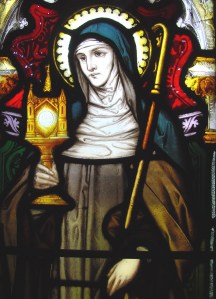
According to Lesser Feasts and Fasts 2003, Clare (Abbess at Assisi, 1253) responded to a powerful sermon preached by Francis of Assisi at the first gathering of his order, calling Christians to a holy life.  His commitment to a life of holy poverty and servant-hood was in part a response to a Church that had lost its way.

Clare was known as a young woman of great beauty, modesty and integrity.  She repeatedly and gracefully resisted attempts by her family to marry her off, and in her position of status was well within her rights.  Her sole occupation was drawing closer to Christ and caring for the poor and forgotten.  She often collected the excess food that was brought into her family’s home and sent this to the poor.

She and Francis visited often, though quietly.  Clare usually went to Francis, as her privileged home did not lend itself to discreet visits from a holy man.  Reports of this relationship suggest what, in today’s Church, we call a vocational discernment process.  As Clare prepared to commit herself to a rule of life – an order – in community with the Franciscan order, Francis designed a daylong “ritual” to mark this enormous transition and “worthily to welcome Clare in the name of the Lord.”[1]  He advised her to dress in her finest clothes and jewelry and to join with others who would process to church for the service of palms, celebrating Christ’s triumphal procession into Jerusalem.  As congregants approached the altar to receive a palm from the bishop, Clare remained frozen out of modesty and shyness; the bishop, taking note of her, walked to her and gave her a palm.  Immediately following this, Clare entered the way of Christ’s passion:

“The heart of this liturgy lies in the moment when Clare, leaving her home and coming out of the city, arrives at Saint Mary of the Angels.  There, setting aside her aristocratic clothing, she is clothed with the garment of the poor who lived in the plain around Assisi and she allowed her hair to be cut by Francis … before the altar of the Porziuncola…”[2]

These “liturgical” acts marked Clare’s transition to a life of holy poverty, committed to the poor and forgotten.

Very little is written or known about Clare, particularly in comparison to what is known and written about Francis. This is how Clare wanted it – her desire was to keep the focus on Francis.  She seemed oblivious of, or unconcerned about, the effect that she had on so many.  That Francis would grant her request to join the order suggests that he could not say “no” to the light of Christ she emanated.  Even the Pope acquiesced when Clare, unruffled by controversy or Church politics, rejected the rule of life he had written for her order of women (familiarly known as the Poor Clares); without argument, he accepted the rule of life she had drawn up.

(Impressions drawn largely from Saint Clare: beyond the legend by Marco Bartoli.)


[1] Saint Clare: beyond the legend, 57.

[2] Ibid.

Posted in Christianity, Ministry, St. Clare of Assisi, Uncategorized | Tagged , , , , , , | 1 Comment

Can we ever see again?

Last night as I was chewing on Matthew’s account of the Feeding of the 5000 for the noon service today in Glenmoor, I found myself drawn not to the miraculous multiplication of bread and fish but instead to the beginning of the text and what immediately preceded it.  John the Baptist has just been brutally murdered.  When the politically powerful Herod made his oath to the daughter of Herodias, he had no way of knowing that he’d be asked for “the head of John the Baptist here on a platter,” and we read that he was “grieved” by this.  Nevertheless, he had made an oath and was compelled to honor it.

The grief that Herod felt and the gut-wrenching sadness that Jesus no doubt experienced over the unjustified, senseless execution of his dear cousin spoke to the anguish so many of us feel over recent events in the nation’s capitol.  Regardless of where people “stand,” if we take a step back and are honest with ourselves, I think we should find ourselves heartbroken.

Jesus withdrew to a deserted place, quite probably to process the painful event of John’s death.  But he was followed by a crowd.  He did indeed feed them, but first he saw them.  These were not the powerful and mighty, the privileged and rich.  These were people quite likely fed up with the politics of their time and hungry for a message of hope – a message that included them, not as a demographic but as men, women and children created in the image of God.  Men, women and children longing for relationship with the God who is love.  Jesus saw them, and they knew it.  He saw them and had compassion on them and healed them.  That was enough.  More than they ever dared hope for.

And then he fed them. 

Posted in Uncategorized | 4 Comments

Confessions of a new church planter

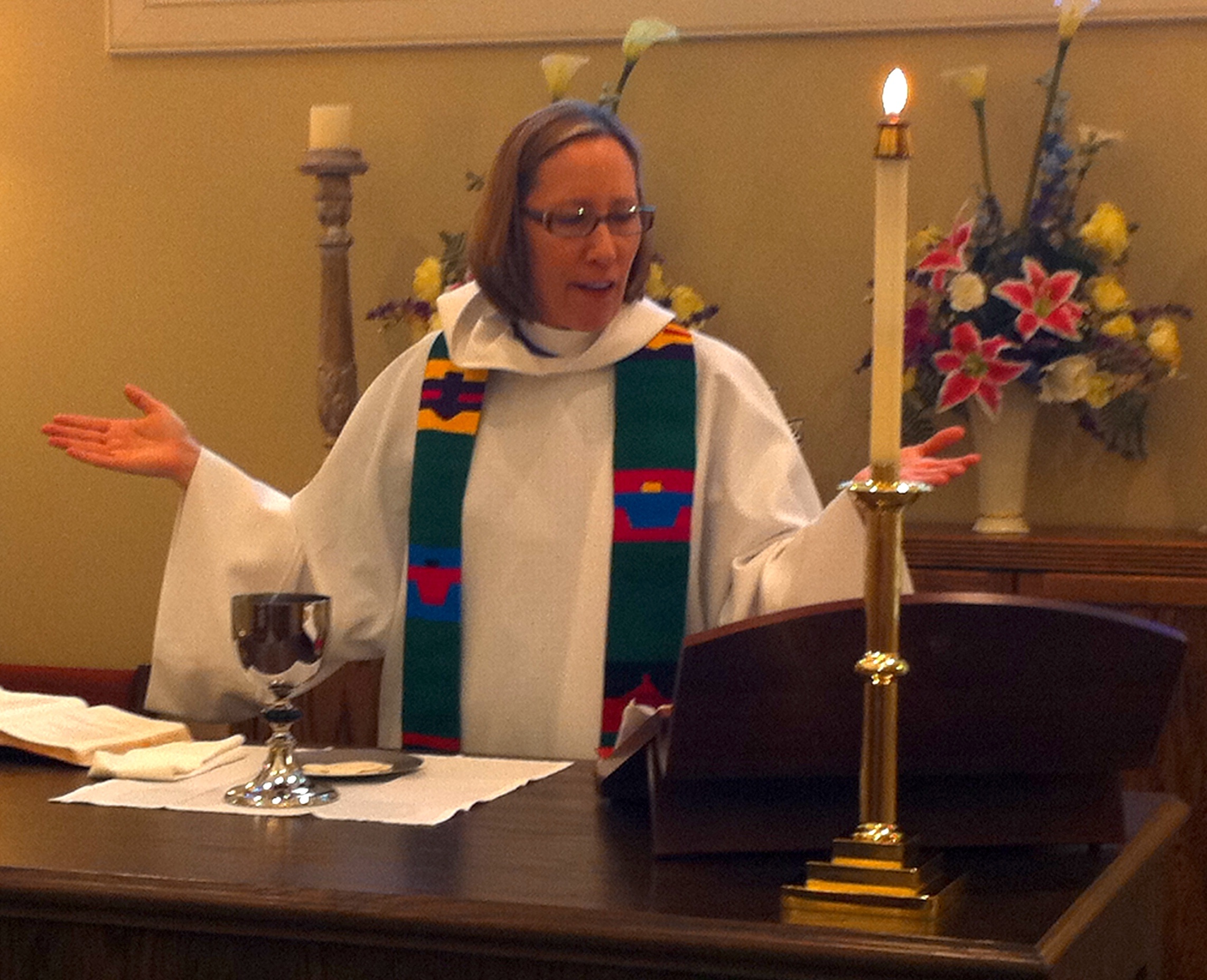
Celebrating communion for the first time.

July marks the second month of my first assignment as a new priest in the Episcopal Church. In partnership with the rector of the church where I serve as assistant (St. Francis In the Field), I am charged with “planting” a new church in the Episcopal Diocese of Florida.  The purpose of this blog is to offer reflections along the way and to invite your prayers, support and comments.

In May I attended Church Planters Boot Camp, a weeklong seminar of the Assemblies of God, a denomination that has very intentionally focused on creating new churches and ministries by equipping clergy and lay people to spread the Gospel and grow the church.  I was humbled and blessed by the hospitality of my Assemblies of God friends, who graciously welcomed me and two other Episcopalians (two rising seniors from my alma mater Yale Divinity School and Berkeley at Yale).

Thanks to generous mentorship, I am learning the fundamentals of being a parish priest and beginning the exciting work of starting a  new ministry to reach those who do not have a church family or spiritual home. In early July, our bishop approved the working name for this ministry — St. Clare of Assisi. Stay tuned!

Posted in Uncategorized | 2 Comments