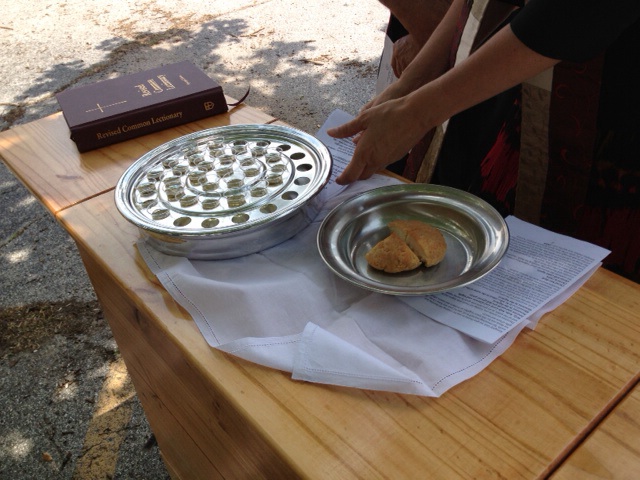
May hatreds cease.

(Photo taken at Trinity Episcopal Church, St. Augustine, FL.)

(Photo taken at Trinity Episcopal Church, St. Augustine, FL.)

Grant, O God, that your holy and life-giving Spirit may so move every human heart that barriers which divide us may crumble, suspicions disappear, and hatreds cease; that our divisions being healed, we may live in justice and peace; through Jesus Christ our Lord. Amen. (Book of Common Prayer, p 823)

Today, for our “church without walls” service, I vested in red – the color of “the blood of Jesus,” as one parishioner noted. Only this day, the red signified also the blood of the 9 Christians brutally murdered at the Emanuel AME Church in Charleston last Thursday.

We spoke about this terror-filled event as a community, and I could tell by the expressions on some of the faces that they were hearing about this tragedy for the first time.

During the Prayers of the People, we prayed for the victims and for the shooter. We prayed for each other and for the Church. We prayed for tolerance for all people.

One congregant took me aside as we were waiting for lunch. “That was awful, Mother Beth. I can’t stop thinking about it,” he said of the shooting, as he shared his feelings of deep pain and upset. “And to think I was so full of hate just like that young man. It was bred into me,” he said of the racism he had been steeped in for much of his growing up, for much of his life (his neo-Nazi tattoos testified to this.)

“But look what Jesus is doing in you,” I remarked, as I looked into his tear-filled eyes. “You remind me that there is hope for all of us.”

This evening, as I mowed my yard, I found myself struggling with something more than grief. It became apparent to me that I carry a wound that can no longer be avoided. It is a wound that comes from the complicity of silence. From the weariness that says, “I haven’t the energy to deal actively with racial injustice; besides I have no idea where to start.”

Twenty-three years ago, I was in Los Angeles during the Rodney King trial, when police officers who were captured on video brutally beating Rodney King, stood trial for their actions. During the time of the trial, I happened to be sponsoring two African American women, who were in rehab. One Saturday night, we went to dinner and a meeting, and the two of them predicted that riots would occur. Blissfully ignorant, I interjected: “How can that be? The police officers are on video beating the man senseless with batons. Of course, they’ll be found guilty!” My friends cast each other a knowing glance as if to say: She may be our mentor, but we need to take the white woman to school. The following week, the riots unfolded in startling fashion from my perspective, but reflecting what was inevitable in my friends’ world.

Today, on Father’s Day, I remember to be proud of the work my father did as a federal judge in the early 70s, drawing up a busing plan to desegregate Duval County when the school board violated federal law by refusing to do so. Our family paid a price during those years. The tension of the time — having people protest and threaten to burn crosses in our front yard; having U.S. Marshalls live with us in our modest. 3-bedroom ranch house; being ostracized by classmates – was like throwing gasoline on the fire of my mother’s alcoholism. It heightened the ever-present sense of anxiety that surrounded us.

What my father did during that divisive, hate-filled time was important. It was a frightening period in our history, and doing the right, just thing took courage. But we had the privilege of having U.S. Marshalls protect us. And my father could have stepped aside, at any given time, like so many others chose to do. We had choices.

I have known my own form of fear, worrying as a child — when my father tried organized crime cases in the midst of threats — if my daddy would make it home okay. I’ve had a tiny taste of what it is to have people – mostly white folks – say hateful, threatening things. But I have never known what it is like to be afraid simply because of the color of my skin.

May the Holy Spirit awaken us to the reality that we are all wounded, we all suffer, whenever and wherever violence and hatred find expression. May Love make itself known in each of us, in our communities and in our world.

Posted in 12-step spirituality, Christianity, faith, Grace | Tagged , , , , , , , , , , , , , | 1 Comment

“Through the wall of flame.”

(Photo taken in my dear friend Darlene's backyard.)

(Photo taken in my dear friend Darlene’s backyard.)

As a frightened man in a burning boat
has only one way to the rest of his life,
we must move with courage
through the wall of flame
into the greater sea.
— Mark Nepo, Book of Awakening, p 172

These words speak to a dear friend of mine, who is going through a harrowing health issue, who is negotiating an ever-shifting landscape full of unknowns.

These words speak to me as I struggle for clarity, and then seek to become willing to make room for all of its implications for my life when it comes.

The imagery of a wall of flame brings to mind the poetry of John of The Cross (known most widely for coining the phrase “dark night of the soul.”). A Spanish mystic, who spent much time in prison for his beliefs, John of the Cross wrote extensively on the growth of the soul. In his writing, the image of bold flames symbolizes loving and transformational union with God.

John of the Cross acknowledges what most of us have experienced if we have lived much in this broken world: in difficult and challenging times – times that cause one to face crucial questions including one’s mortality — it may seem like God is absent. But John calls us to remember that God is ever with us, that we are being prepared and transformed by love if only we will be present and lean into the experience as authentically as possible. If we will trust there is life and depth for us in whatever our circumstances, in spite of sometimes substantial evidence to the contrary.

A good sign for me that something is afoot — that God is shaking things up — is a growing resistance to sitting still in the Great Silence. In the midst of many blessings and meaningful work, I find myself restless, uncomfortable, and finally (after enough pain) driven to lean in again, to surrender to whatever it may be that God is unleashing.

This will be interesting.

Posted in 12-step spirituality, Diocese of Florida, Episcopal church, faith, Grace | Tagged , , , , , , , , , , , | Leave a comment

“It is finished.”

(Photo taken at Trinity Episcopal Church in St. Augustine, FL.)

(Photo taken at Trinity Episcopal Church in St. Augustine, FL.)

This reflection was offered as part of a series of readings and reflections on the last seven words of Christ at St. John’s Cathedral, Jacksonville, FL, April 3, 2015.

When Jesus had received the wine, he said, ‘It is finished.’
Then he bowed his head and gave up his spirit. (John 19:30)

“It is finished.”
When we hear these words of Jesus,
we are tempted to move quickly to
an explanation of their greater meaning.
We want to paint the big picture,
to say that Jesus has paid our debt,
has conquered sin once and for all,
has accomplished the work which the Father
sent him to do through his earthly life.
We want to fast forward to the celebration
of all that this signifies.

But it is not time for celebration.
We come this day to Golgotha,
to sit at the foot of the cross.
To be with Jesus as he bows his head,
as the blood and water – the last bit of life force —
flow from him.

Imagine being one of Jesus’s followers,
without benefit of the full story.
Imagine listening to him teach.
Imagine breaking bread with him.
Being close enough to witness miracles
of healing and deliverance,
close enough to witness the generosity of
a merciful God who feeds his people,
who weeps with us and comforts us.
Imagine sensing that this man from Nazareth
is the King of Glory.
Though this is a dangerous, turbulent time,
the excitement and promise of Jesus
tamp down our anxiety.

But in time trouble comes.
Jesus has attracted too much attention.
And following him has become dangerous.
Hopeful anticipation and expectancy are
crowded out by profound confusion
and fear as Jesus is arrested.
The sense that the end is near is palpable.
Any hopes of a new day are dashed.

“It is finished.”
To hear Jesus speak with such finality
must have been chilling.
I imagine in some form those words
reverberated in the hearts of the disciples
who had fled,
who dared not risk being present for Jesus’ execution.

When I imagine this scene, I cannot help but
think of our own Ben Clance.
Or of my social worker friend Sara Flynn Baldwin,
both of whom work on behalf of death row inmates.
Both of whom walk alongside prisoners,
praying, singing hymns, keeping vigil,
even witnessing executions.

A couple of years ago Sara asked me to
visit a young man who was waiting to be
resentenced for a series of armed robberies.
At age 16, Asa had been sentenced to life without patrol,
something the Supreme Court deemed unconstitutional.
You cannot give up on someone
who’s brain hasn’t fully developed.
Asa and I visited over the course of a year,
and I came to know a young man who
was very bright and full of promise.
It is a miracle he was even alive.
His parents were crack addicts who began buying
him pot when he was 10.
After they turned him out onto the street,
a career criminal took him under his wing.

At the resentencing hearing, a few people
showed up to support this young man:
a social worker, a former teacher, an aunt.
After the sentencing, the judge allowed
him to turn his chair and face us,
to visit for a few minutes.
He had difficulty looking at us,
even as we assured him of our love.

A couple of weeks later, he told me:
“I felt so ashamed in that court room,
I couldn’t look at you.”
After waiting nearly 2 years for resentencing,
there was no more wishing for quick release.
Asa will be in his 50s before he is free.

If we live long enough most of us will have a time
where we feel that all is lost —
that “It is finished.”
The loss of a friendship or business or marriage.
Colossal failure, ethical breaches,
seemingly irredeemable mistakes.

Such pain and suffering is something
we want to avoid, whether it is our own
or someone else’s.
Sometimes I am no better than the disciple
who saw the writing on the wall and fled,
in search of a safe place to hide from the storm.
There are times I have walked away from
friends and associates, perhaps fearing
I’d be engulfed by their agony and shame.

But the love of Christ calls us to the foot of the cross,
to draw closer to one another in our suffering.
This is a place where there are no easy answers.
Just the reality of our own poverty,
emptiness, and defeat.

Jesus tells us we must take up
our cross and follow him.
Can we find it in ourselves to sit with the one
who has failed, who is shamed,
who seems lost beyond all recall?
And can we find it in ourselves to allow
another to see our naked suffering,
our utter hopelessness?

Yesterday I was able to hold the hand of a man,
whose body has been ravaged by addiction.
He was covered in tattoos.
When I first met Paul, he showed me where
the numbers 666 are tattooed on his eyelid.
He was adamant that there was no hope for him,
that he had done too much bad in his life.
“It is finished,” I could hear him say.
There is no more.

After a few months of attending Church Without Walls,
He began to receive communion.
Some weeks ago he began reading the scriptures
printed in our bulletins.
He prays every day and has felt
the Spirit come upon him.

I wondered aloud if he might consider
being baptized on Easter, and he resisted.
But when I explained that in baptism we share
in Christ’s death, this made sense to him.
He understands death.

In truth, we are each called to make room
for suffering and death.
We may deny it, but we all know it.
We come together to wait at the foot of the cross.
Because even if this were the end of the story,
even if there were no more to come,
being present matters.
To show up for one another.
To acknowledge suffering.
To affirm the end of our hopes and dreams.
These too are holy moments.
These too are sacred times.
Amen.

Posted in Baptism, Christianity, faith | Tagged , , , , , , , , , , , | 1 Comment

Love abounds.

20130912-081725.jpgLast week I experienced disappointment and failure in a fairly public way. I also experienced a mind-blowing, heart-expanding outpouring of love and encouragement from friends, colleagues and loved ones.

Once again, I am reminded that, without risk and messiness, I would never know grace. I would not begin to comprehend mercy. I would not experience that creative Love that loves simply because love is its nature.

Last Tuesday, my friend Patrick and I laughed, cried and swore as we invented innumerable “crap” jokes on our drive home from South Carolina. We celebrated his success and my failure simultaneously with a delicious island feast, compliments of “Jamiaca Me Hongry, Mon” in Wadley, Georgia. It was pretty evident that the only other people to cross the threshold of that restaurant that day were the three employees who greeted us like long lost cousins. The gifts of presence, adventurous curiosity, and openness blessed us all. Blessed me mightily.

If that weren’t enough, I checked in with my home group this evening and was informed that, in my absence, all the guys had hatched a plan: they will be coming to Church Without Walls for Easter and will help with set-up and the meal. (You won’t want to miss that glorious service of worship and baptism followed by an incredible feast. You can trust me on that!)

The entire Creation was birthed in love and generosity. With each new day the Spirit shows itself gloriously, both as blessing and blessed.

Posted in 12-step spirituality, Baptism, Christianity, faith, Grace | Tagged , , , , , , , , , , , , | 1 Comment

A third way.

(Photo taken of icon gifted to me by St. Francis In the Field parish.)

(Photo taken of icon gifted to me by St. Francis In the Field parish.)

Recently I was in a conversation with a friend, who expressed that he vacillates between two different ways of relating to me: blunt assertiveness or drawing back with a very passive stance.

I understand where he is coming from. But something about his assertion doesn’t ring true. Are there really only two options in how we relate with one another? Taking a step back, it is not hard to see the limitations of such a view. How about considering a third option? What if we were to agree to stop dancing that same old tiresome two-step? What if we were to try something new? And then, if that doesn’t work, to try something else?

There is nothing like that feeling of being set free after feeling confined and restricted by a habitual way of being in the world, of being with others. That’s not to say the new way isn’t pretty daunting at times. That’s not to say the new way won’t bring it’s own set of challenges. But, how wonderful it is to discover a third way – and to sense the possibility of limitless options if only we open ourselves to them.

My prayer this day is for courage, wisdom and possibility. My prayer is for inspiration and new dance steps, for the willingness to experiment with new ways of being on this new day. I pray for a renewed sense of hospitality and adventure and the grace and joy to allow each of us to try out new dance steps in a spirit of humility, tolerance and joy.

Posted in faith, Grace | Tagged , , , , , , , , , , , | Leave a comment

“Bless these gifts.”

(Photographed in the "garden of hope" at Clara White Mission, Jacksonville, FL.)

(Photographed in the “garden of hope” at Clara White Mission, Jacksonville, FL.)

Over the past two or three days, I find myself needing to unfurl my clenched fist, to loosen my grip and let go.

I find myself longing to integrate parts of myself and my journey that might seem incongruent or incompatible from the outside looking in. Parts that have been discarded, forgotten or set aside. But these are steps on the journey, each bringing its own challenges. Each with its own gifts. Each of great value. I want to own and appreciate it all. Nothing is wasted in God’s economy.

I was asked this week to describe my theology – my understanding and experience of God. The theme that dominated this conversation was “community.” Though I need regular times apart – times of quiet and reflection – I need the experience of community just as much. It is in community with fellow strugglers/seekers/truth-tellers that I am able to encounter God. And it is in the midst of loving community that I discover my deepest, truest self.

Sometimes you challenge me, and I feel caught up short. But that is part of the process. When you bring to the table all of your gifts – your struggle, your confusion, your passion and your hope – you are a blessing beyond measure. May we trust one another and God enough to remain in community, to invite the stranger, to stretch toward our best selves. May we discover, uncover and embrace all that God has for us.

Come, Lord Jesus, our guest to be,
And bless these gifts bestowed by thee.
Bless our loved ones everywhere,
And keep us in your loving care.

— adapted from a Moravian table prayer

Posted in faith, Grace, peace | Tagged , , , , , , , , , , , , , , , | Leave a comment

“Romance, finance and self-importance.”

(Photo taken at Holy Cross Monastery)

(Photo taken at Holy Cross Monastery)

Just this morning I heard a friend make the observation that “romance, finance and self-importance” are the three areas that are most likely to get him off-track. These distractions — trying to find love, scrambling for money or seeking an ego boost — can be stumbling blocks.

It has been a long time since “romance” or “finance” caused me much heartburn. My lack of obsessing in those areas likely has as much to do with the passage of years as it does any spiritual discipline. And I don’t see myself pre-occupied with self-importance in the conventional sense. But I do know something about ego.

God has a funny way of helping us come face-to-face with whatever demons or shortcomings we need to face. At this point in my life and ministry I do not desire being the center of attention or being elevated to some position of importance. Ironically, though, I seem to get more and more invitations that pull me into the spotlight – I feel myself resisting this, but I usually comply with the requests, as they are opportunities to share more about our “church without walls” ministry. Each time, I must confront self-centered fear. Each time, I must remind myself that it’s not all about me.

That self-centered ego bypasses logic and reason to tell me in a very visceral way that I will die if you discover how impoverished I really am. When I sense that I am about to be found out and exposed, I go into survival mode on a body level, as if my very life is on the line.

Oddly enough, this is good news. If I will sit still and be quiet, if I will prayerfully allow these feelings and sensations to move through me, then I stand a chance of allowing God to help me separate from my “false self,” from that image or mask that I am often eager to maintain and defend. If I sit still long enough to acknowledge to myself and to God that I am a mass of quivering jelly, then the possibility for being freed from this false self comes into play.

This week, on Ash Wednesday, we will pray one of my favorite prayers:

“Almighty and everlasting God, you hate nothing you have made and forgive the sins of all who are penitent: Create and make in us new and contrite hearts, that we, worthily lamenting our sins and acknowledging our wretchedness, may obtain of you, the God of all mercy, perfect remission and forgiveness; through Jesus Christ our Lord, who lives and reigns with you and the Holy Spirit, one God, for ever and ever. Amen.”

This prayer reminds us that we are a beloved part of God’s magnificent creation. None of us is a mistake. God hates nothing he has made. God wants each of us to be the creature he envisioned before we ever took a breath.

I want to be freed from that scaffolding I have acquired, from that false self that no longer serves me. I want to release the expectations I have placed on myself and to discover what on earth God had in mind when he made me.

This morning a dear friend handed me a beautiful medallion, inscribed with the words “To thine own self be true.” With God’s help, may it be so.

Posted in 12-step spirituality, Christianity, Diocese of Florida, Episcopal church, faith, Grace | Tagged , , , , , , , , | Leave a comment

Becoming friends.*

(Photo taken at a Church Without Walls service.)

(Photo taken at a Church Without Walls service.)

It was my privilege to preach this sermon at the 172nd Convention of the Diocese of Florida at Holy Trinity Church in Gainesville, Fl, on Jan. 30, 2015.

Micah 6:6-8
Hebrews 12:1-2
Matthew 25:31-40
Psalm 15

O Lord, may only your word be spoken here.
May only your word be heard.
In the name of God, Father Son and Holy Spirit. Amen

Last week I sent an email to my folks:
Please pray for me, I wrote.
I am terrified to preach at convention,
and I have absolutely nothing to say.

Perfect, Marcia responded. A blank slate.
Just tell us what you have learned.
Tell us what your people want to say.

My people.
The people who come to Church Without Walls.
The hungry. The thirsty.
The stranger. The sick.
The prisoner. The lonely.
And the forgotten.

What would they want me to say?

About three weeks ago we had our monthly
congregational meeting.
Anyone who has ever attended a Church Without
Walls service gets seat, voice and vote.
We gather for prayer and fellowship.
We talk about what is meaningful to us
about our gathering and what we hope that
our community will become.

This particular gathering was small
but representative:
Darlene and Bob, who drive in from their home
In Ponte Vedra Beach;
Cathy, who comes from Baymeadows;
Zeno, who lives in alternative housing in the urban core;
Thurman, a resident at Trinity Mission, who has
served as our chief greeter for more than a year;
Robert, who rides the bus in from the Northside
where he camps with others; and
Mr. Cook, a severely delusional man,
who participates in all of our activities.

As we dreamed our dreams for the future,
I noted that one of our members recently
had gifted us with a music stand –
a sure sign that God will raise up a choir
in our midst.

As we pondered this, Thurman spoke up.
“No, Mother Beth, no. I don’t think that
a music program is such a good idea.
At least not now,” he shook his head vigorously.
“Why not?” I asked.
“Because people in other churches need a reason
to come worship with us.
If they have a job to do — bring music or lunch –
they are more likely to come.
And if they come, then they’ll have a chance
to experience God here.”

Often, this is exactly what happens.
Those who visit us as a curiosity are startled to
experience Jesus in a very tangible way.
Some time ago, a youth group came to worship with us.
Before the service, a woman from the visiting church
sat next to a man who was with us for the first time.
He was neatly dressed but visibly
downtrodden in spirit.
As she began to speak to him, he interrupted her:
“Lady, I don’t know why you’re sitting with me.”
“Maybe God wanted us to meet,” she told him.

Eventually, he shared that he was having a
terrible time with anger.
“What’s that like?” she asked.
“It’s awful,” he said. “It’s like it hurts
all the way through my entire body.”
With that, she called over one of the young boys
from the youth group.
“Billy, you struggle with anger, don’t you?”
“Yes, ma’am,” he replied.
“What’s that like for you?” she asked.
“It’s terrible,” he replied.
“It’s like it hurts all the way through my entire body.”

This is what Thurman is talking about.
This is what Thurman wants us to know.
The power of Divine Love in action,
acting upon each person who experienced
that conversation.
Acting upon each one of us.

“We love because he first loved us.”
This verse – the theme for our convention –
sounds like a mission statement,
but it is much more than that.
This Love that created us all is living and dynamic.
Our experience with it is more like a dance –
an exchange of give and take.
I don’t know about you but I need to
experience this love again and again.
This interrelatedness, this giving and receiving
speaks of an active, living relationship with our Creator.

The One who knit us together in our mother’s womb
longs to knit us together anew –
as a community – as a living body that moves in
a transforming relationship with and in the world.

Ministry involves doing good in the world –
and our diocese does plenty of amazing things:
Delivering dental care to the working poor
and homeless.
Providing food and health care in rural
communities and in the inner city.
Educating children, and housing and caring
for the elderly and disabled.
And encouraging and accompanying the prisoner
and the newly released.

Jesus calls us friend.
And he calls us into a place of risk and
sacrifice as we learn to become friends with
the unlovable — just as we have been loved
and befriended ourselves.

The essence of ministry is always personal.
We are called to be friends of God.

So what might that look like?

“I was a stranger and you welcomed me.”
Are we willing to be with a stranger
in their isolation?
To sit with the guilty and shamed,
whether they exist in a literal prison or
a prison of addiction, greed, mental illness, or
chronic poverty?

What God requires is too much
for any one of us.
But we can do this together.
And when we risk being friends –
when we risk being vulnerable,
not just as individuals but as a community –
we will experience the love of Christ in a way
that is real and meaningful.

Many a Sunday I am not feeling it.
But I’ve been taught to suit up and show up.
And then, one-by-one, the people, driving in
from across town or arriving on foot,
gather under a sycamore tree in the
middle of a parking lot.

Christ-bearers – missionaries — one and all.
Something amazing happens when we
strip church down to its bare essentials –
the people, an altar, bread and a cup.

It seems so small, this gathering that we do.
Can it possibly make a difference?
Often I wonder how on earth are we
to do justice, love kindness, and walk
humbly with our God?
I don’t have a simple, one-size-fits-all answer for you.

But I do know this:
These pews are filled with people who
are working to ensure justice and mercy
in our broken world,
whether taking on a corrupt, cruel prison system;
or welcoming the foreigners in our midst;
or feeding and tending the broken-hearted,
who are exhausted and defeated by relentless poverty.

When the work seems too overwhelming,
we need only remember this simple truth:
All that Jesus requires of us begins at that table.
The bread and the cup are a perpetual
source of new life.
At the table, we celebrate not only
what Jesus has done for us but
what he is doing right now.

One of our Church Without Walls parishioners —
Carey – lives with untreated mental illness.
For months I would spot him hovering
at the edge of our gathering.
One Sunday, at the end of the service,
he suddenly appeared before me at the altar,
as I was putting things away.
“Would you like to help consume
the remaining bread?” I asked.
As I handed him a piece of bread, he spoke up:
“I want the prayers with it,” he said.

That was the first time he received
communion with us.
Now he no longer hesitates to join with
the rest of the community.
And he participates in fellowship, engaging
regulars and visitors alike with
his unique take on reality.

I can’t say for sure what has happened in Carey.
But I do know this:
He is a beautiful part of this living body,
which God continues to knit together.

Holy communion is the great equalizer.
We come to the table just the same—
hungry, thirsty, defeated and looking for hope.
We offer the only thing we have –
our radically imperfect, broken selves –
depending on the mercy, kindness and humility
of a God who gave everything because he loves.

When we remember that church is about relationship,
about building genuine community,
we are free to experience Jesus in a way that
is immediate and life-changing.
What if instead of just counting revenue and
average Sunday attendance,
we were to track things like:
Have any of us experienced reconciliation this year?
How often did we stop a church meeting and ask:
“Who’s voice is not represented here?
How many difficult conversations were we willing
to have around alcohol and substance abuse?
How many times did we gather with the
church down the street, across the diocese,
or in a distant land, to share dreams and
help to carry one another’s burdens?

The Holy Spirit is at work,
and can do great work through us!
Jesus asks us to suit up and show up.
We aren’t required to solve all suffering,
but we are asked to make it personal,
to be friends with those struggling in our midst.
In this way, we become friends of God.
And Jesus rejoices in our friendship.
Amen.

*This phrase comes from Paul J. Waddell’s beautiful book Becoming Friends: Worship, Justice, and the Practice of Christian Friendship.


Posted in Christianity, Diocese of Florida, Episcopal church, faith, Grace, Recovery, Uncategorized, unity | Tagged , , , , , , , , , , , , , , , , , , , , , , | 4 Comments

Boundaries.

(Photo taken at Camp Weed.)

(Photo taken at Camp Weed.)

Got a call today from a well-meaning Christian person who has a “really cool project idea,” making videos to send to family and friends from whom individuals may be estranged.

They have a great idea – they just need access to our Church Without Walls congregation to execute it. He was ready to come this Sunday.

What bothers me is the rush, the push, the hurry. Are you willing to come hang with us every Sunday for a while before you begin to diagnose what folks need? Are you willing to sit and pray with us a while and to discern what you might need?

People who want to swoop in and do good deeds without even getting to know us bothers me. A lot. It smacks of using people rather than truly getting to know them. It smacks of taking from a community rather than entering into it.

God, give me patience and compassion for well-meaning people. And strength to stand by what seems right.

I told this person: “Let me talk with the community first and see what they want to do.” He struggled with this, wanting instead to just show up. “For me to allow you to do that would be to betray the trust of this community. That’s what we are – a community.”

Jesus isn’t about projects and programs. He is about relationships, first and foremost. If I wonder which relationships to work on first, I need only look at who is in front of me. In our baptismal covenant, we promise to respect the dignity of every human being. That includes allowing each person to have a voice. It includes allowing others the dignity to say “no thank you” to another’s good idea for them.

Maybe I should tear a page from the playbook from our congregants, who, when someone at church is getting a little out of line or inappropriate, will say: “Not here, man. This is church.”

Posted in Christianity, Diocese of Florida, faith, Grace, Uncategorized | Tagged , , , , , , , | Leave a comment

“I was sick and you visited me.”

Last night I had a troubling dream. This dream is not about Bishop Heather Cook of Maryland though the tragic, heart-breaking events that resulted quite appropriately in her arrest no doubt got my subconscious riled up. Be forewarned that this is not a pretty dream. It is a glimpse into the dark night of my own soul.

(Icon written by Eduardo Santana of Bolondron, Cuba.)

(Icon written by Eduardo Santana of Bolondron, Cuba.)

In my dream I walked into a cathedral or church much like the beloved cathedral, which raised me up. In this dream cathedral, the chancel area, where the altar is, was very tightly furnished. I walked up the chancel steps carefully, as I held the hand of a friend who moved right behind me. She was close to me, and extremely familiar, but I could not see her face. She was unsteady on her feet and had a sour smell about her. The church service had not yet begun. We took seats side-by-side in a choir stall. I looked over at my friend, who seemed sad and somewhat disoriented. I couldn’t help but notice the vomit that covered her long draping shirt. I averted my eyes and pretended it wasn’t there, hoping in my pretending that others would overlook it as well. Hoping beyond hope that, even as more vomit spilled out of her, no one would notice.

At one moment, I popped up. “I need to vest,” I exclaimed, feeling happy to remember that the Dean very often asks me to vest and process in, to sit with the clergy. But my friend’s sticky hand continued to cling to mine and, as I looked back at her, I knew I was not going anywhere. Though I longed to be with my colleagues, this one needed me more. The truth was, I desperately needed to be with her, to sit beside her, even in her misery and suffering.

Suddenly (as things happen in dreams) it was time to receive communion. The sanctuary had grown dark, and it was difficult to see. My friend and I rose and walked hand-in-hand around the altar until we came to stand, just the two of us, at a place beyond the altar. A hand appeared, reaching out of a dense fog — out of nothingness or heaven or God only knows what — extending toward us, offering a small piece of bread. I felt something wet against my feet and looked down as the vomit continued to flow. It sickened me so that I wondered for a moment if I would be sick, too. But I wasn’t. A long moment passed as the arm hung in the air, still offering the bread. I realized then that it wasn’t possible for my friend to receive the bread, she was too sick. I will have to receive it for her, I realized, until she is well enough to receive it for herself.

In time, I will know more about what my dream-self is trying to say to my “conscious” self. Oftentimes, I have wanted to deny those parts of me, which I find unacceptable or disturbing or repulsive. It is natural to want to abandon that which is weak or sick or disruptive. But I have found that healing comes when I am willing to make room for that which is difficult, confusing and disturbing. I do not know what, if anything, this dream has to do with Bishop Heather. But I do know part of the disturbance and intense upset I feel around that tragedy is a knowing, not far below the surface, that sickness, danger and selfish carelessness are not strangers to me.

Posted in 12-step spirituality, Christianity, faith, Uncategorized | Tagged , , , , , , , , , , | 1 Comment